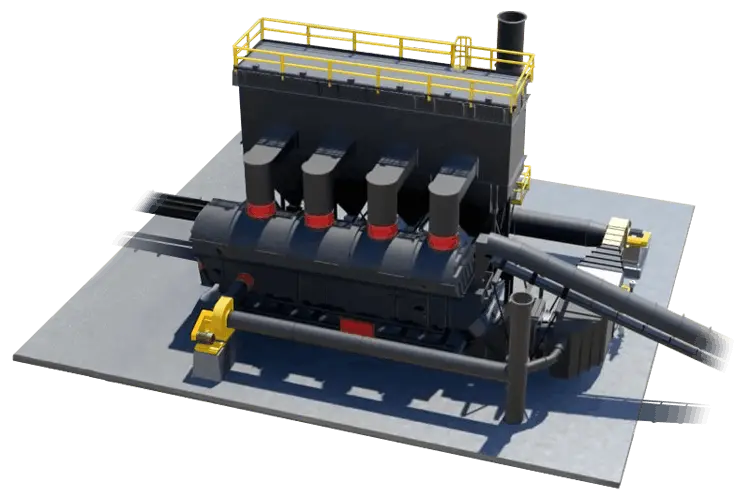
Fluid Bed Dryers for Industrial Drying Applications
Fluid bed dryers are widely used in bulk solids processing where uniform moisture removal, controlled temperature profiles, and consistent product quality are critical. Carrier Vibrating Equipment engineers both vibrating fluid bed dryers and conventional fluid bed dryers to handle a broad range of materials, from fine powders to granular minerals and temperature-sensitive solids.
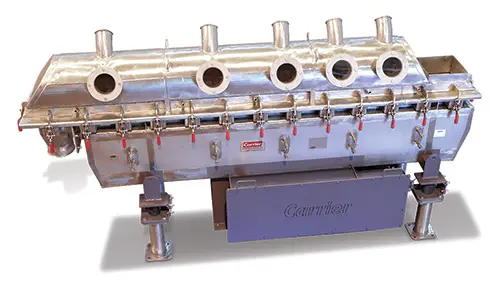
Our Systems Deliver
Whether your application requires drying, cooling, or a combination of both, Carrier designs fluid bed dryers to match your material behavior and production goals. From even heat transfer, precise moisture control and continuous-duty reliability to energy-efficient operation and custom-engineered configurations, our systems deliver consistent product quality, reduced operating costs, and dependable performance in demanding coal drying applications.
Each solution is engineered around your specific process requirements material behavior, feed characteristics, thermal profile, throughput, and downstream integration.
Vibrating Fluid Bed Dryer Solutions
Designed for materials requiring controlled conveyance, improved flow, and uniform thermal exposure.
Conventional Fluid Bed Dryer Solutions
Designed for stationary-bed drying applications with stable airflow and consistent heat transfer.
How Fluid Bed Dryers Work
Fluid bed drying works by passing controlled airflow through a perforated bed of material. As air lifts and surrounds the particles, moisture evaporates uniformly across the entire product mass. Depending on the application, vibration may be used to:
The result is efficient drying with predictable residence time and uniform final moisture.
Why Choose a Fluid Bed Dryer?
Fluid bed dryers are selected when applications require:
Compared to other drying technologies, fluid beds offer improved product quality and better process control.
Applications & Materials
Carrier fluid bed dryers are engineered for:
Each system is designed based on moisture content, particle size distribution, bulk density, throughput targets, thermal sensitivity, and plant layout constraints. No two fluid bed dryers are identical, each is engineered for its specific material and process.
Technical Advantages
Carrier fluid bed dryers offer:
All dryers are engineered to integrate with upstream feeders, conveyors, calciners, and downstream screening or cooling equipment.
Selecting The Right Fluid Bed Dryer
Choosing between vibrating and conventional designs depends on:
Carrier engineers evaluate your material through application testing to determine airflow rates, residence time, and vibration profile before fabrication.
Frequently Asked Questions