
Conveying, Feeding & Screening
Carrier offers a variety of industrial conveyor and feeder systems, with designs uniquely configured to meet your needs and application. From vibrating conveyors to units with screens and air knives, our industrial conveying and feeding solutions solve a variety of customer challenges. Our conveying, feeding, and screening material handling equipment provides gentle handling of materials and proven reliable and energy-efficient.
Material Handling Equipment Types
Customized To Your Application
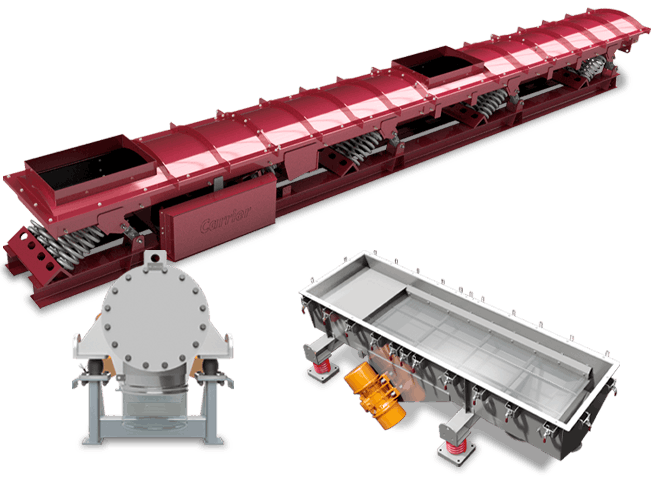
Vibrating Conveyors, Feeders & Screeners
Move material through any process line with Carrier’s energy-efficient vibratory conveyors, feeders, and screeners. Options such as two-way conveying, perforated plates or screens, dust tight enclosures, sanitary designs, and heating and cooling jackets are available.
Conveyors
Provide efficient processing including drying, cooling, classifying and sterilizing with Carrier conventional fluid bed dryers and coolers.
Feeders
Cost-effective in the production of super fine powders from liquid phase reaction or wet grinding operations. High viscosity materials.
Screeners
Inexpensive solutions to drying powders and granular materials. A flash dryer can use higher gas temperatures than most other type.
The Basic Theory of Material Handling Machines
Depending on the application, materials may be conveyed in a continuous stream, metered at controlled rates, or separated based on particle size. As material moves through the equipment, factors such as particle size, moisture content, density, and flowability influence performance. Properly designed systems ensure consistent material movement, prevent buildup or segregation, and maintain uniform feed rates to downstream processes.
Conveying – Natural Frequency
An industrial vibrating conveyor’s operation is typically based on the natural frequency principle. At the natural frequency, the conveyor will vibrate indefinitely with only a small energy input. Once the drive initiates the conveyor’s vibration, the supporting springs help maintain constant motion under the conveyed load, by alternately storing and releasing most of the required energy.
Conveying, Feeding & Screening
A vibrating conveyor, vibrating feeder or screener typically consists of a base member below a spring-supported horizontal pan (or trough). The pan can be modified with various equipment, such as liners, screens, etc. The drive is typically an electric motor with a fixed eccentric shaft or a rotating weight. In operation, the drive transmits vibration through the support springs to the pan, counterbalance, or base member. The vibration of the pan continuously throws the material upward and forward, thus moving the material in short hops along the conveyor.
Four Basic Types of Vibrating Conveyors:
Air Knife Separators
The air knife system provides an effective, efficient means of separating heavy metal, stone, plastics, paper and other debris from aluminum beverage container (UBC) scrap. This process is intended to reduce residual contaminant build-up in the recycled alloy, reduce furnace melt loss and recover other recyclable materials from the aluminum such as lead, copper, paper, plastic, etc.