
Vibrating Fluid Bed Coolers
Is your cooling process delivering uniform product temperatures while protecting material quality?
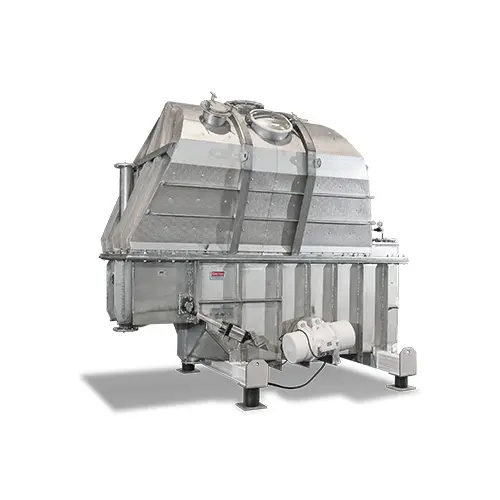
Fluidized Bed Coolers
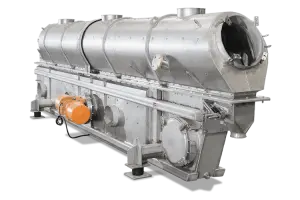
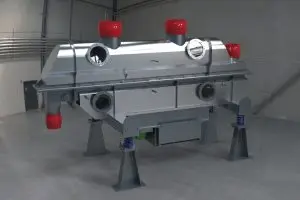
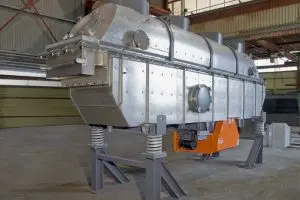
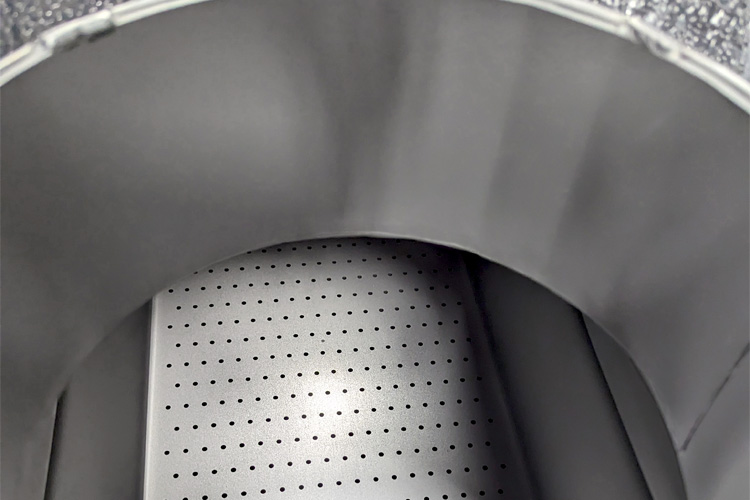
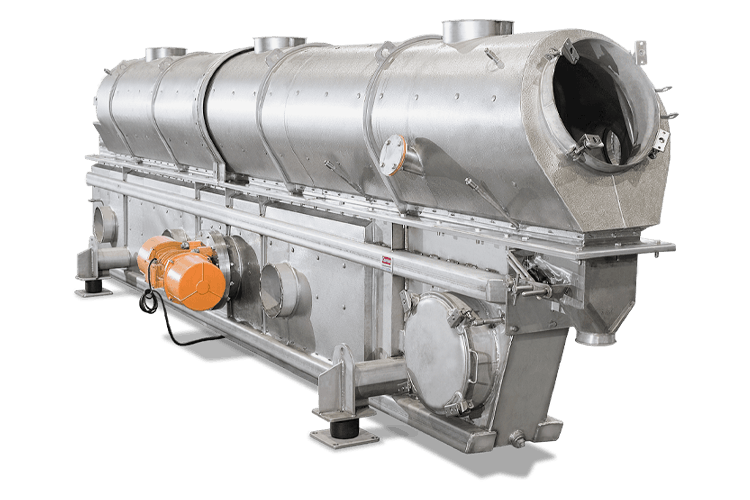
Carrier vibrating fluid bed coolers are designed to cool a variety of products at a wide variation of feed rates. Much like our Vibrating Dryers, Vibrating Fluid Bed Coolers function by passing process air directly through a bed of solids via a perforated plate or another type of fluidizing media. Vibration is added to aid in the fluidization of more difficult-to-fluidize materials. From once-through fluid bed process systems and partially recirculated systems to self-inerting fully recirculated systems, Carrier Vibrating Equipment designs complete customized solutions optimized for process cooling.
Features & Benefits
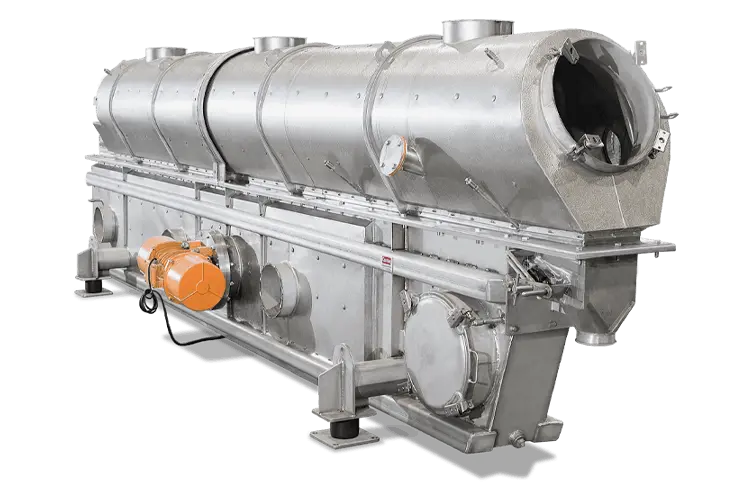
Equipment Options & Accessories
Make on-line changes to the angle of vibration for precise control of retention time, maximum fluidization, and processing of multiple products.
Over 100 deck designs ensures the proper fluidizing deck for precise airflow and consistently distributed heat.
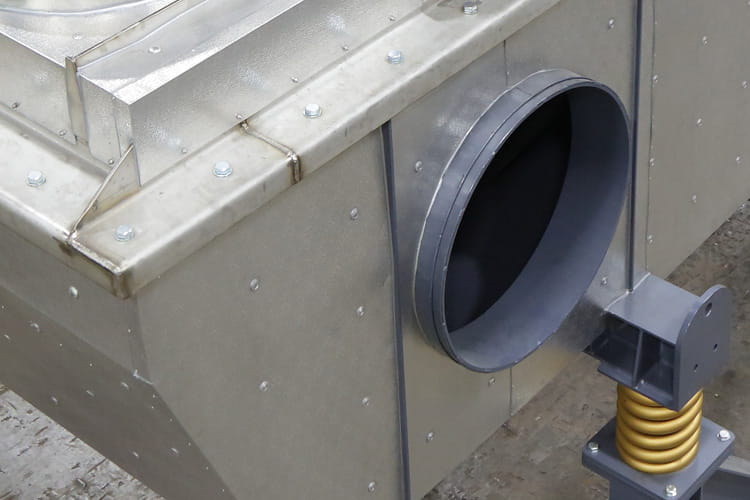
Significantly reduce the low dynamic reaction transmitted through the fluid bed isolation springs by up to 96%.
Sanitary, U.S.D.A. (3A) approved vibrating fluid bed cooler construction for food processing.
Material contact surfaces can be fabricated from carbon steel, stainless steel, titanium,
Inconel® or a number of other alloys. Specialized coatings are available to reduce product adhesion.
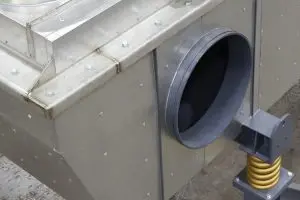
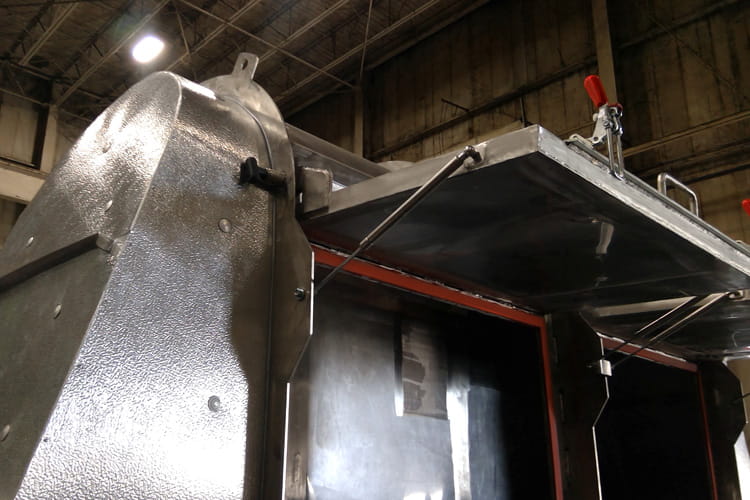
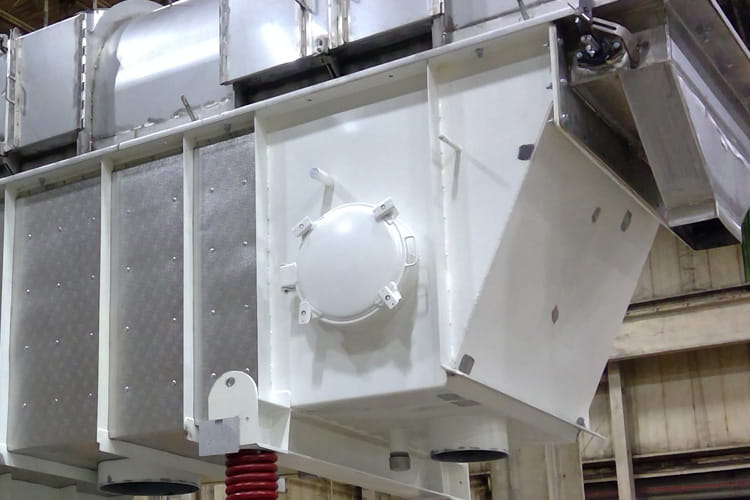
Access the plenum and deck with a variety of customized manways and doors.
Clean-in-place (CIP) and fire suppression systems available as part of the vibrating fluid bed cooler, where necessary.
Re-circulated gas and closed-loop systems are available for improved efficiency or solvent recovery.
Available in low or high vibration designs to process the widest range of materials.
All system components can be designed with fire and explosion prevention, detection, and suppression systems.
Minimize field commissioning work with simple starter panels or customized PLC-based controllers complete with remote startup and engineering services.
Applications
Carrier vibrating fluid bed coolers rapidly and uniformly reduce the temperature of extruded, pelleted, and processed feed products prior to screening, coating, packaging, or storage. Controlled fluidization and vibratory conveying provide consistent residence time and efficient heat transfer while minimizing pellet breakage and fines generation.
Provide controlled cooling of calcined bauxite, clay, and other mineral products following high-temperature thermal processing. The combination of vibration and fluidization promotes uniform heat transfer and reliable solids movement while handling abrasive, high-temperature materials.
Reduce the temperature of wood pellets, biomass particulates, and thermally processed renewable feedstocks before storage, handling, or downstream processing. Efficient air-to-solids heat transfer and controlled residence time help achieve uniform product temperatures while minimizing degradation and material buildup.
Deliver precise temperature reduction for catalyst products and intermediates following drying, calcination, or other thermal processing steps. Uniform fluidization and gentle vibratory transport help maintain particle integrity while achieving consistent discharge temperatures.
Efficiently cool cement, supplementary cementitious materials (SCMs), clinker-related products, and other hot mineral solids following thermal processing. High-efficiency heat transfer and controlled solids residence time provide uniform product cooling while accommodating abrasive, fine, and high-temperature materials.
Provide controlled, uniform cooling of crystalline, granular, and particulate chemical compounds following drying, reaction, crystallization, or other heat-intensive processes. Adjustable airflow, vibration, and residence time allow discharge temperatures to be precisely controlled while minimizing thermal exposure.
Deliver efficient cooling of hot coal and coal-derived materials following drying or thermal processing. Fluidization increases contact between cooling air and solids, while vibratory conveying provides controlled movement and uniform discharge temperatures.
Rapidly reduce the temperature of granular and prilled fertilizers following drying, granulation, or other thermal processing. Controlled fluidization provides efficient heat transfer, while gentle vibratory conveying helps minimize attrition and fines generation.
Provide sanitary, controlled cooling of food ingredients, grains, dairy products, powders, and particulate foods following drying or thermal processing. Uniform fluidization and gentle conveying promote consistent product temperature while allowing cooling conditions to be tailored to moisture-sensitive or heat-sensitive products.
Efficiently reduce the temperature of hot sand, aggregates, frac sand, and other mineral products following drying or thermal processing. High-throughput vibratory conveying combined with fluidized air provides efficient heat transfer and consistent discharge temperatures for subsequent screening, classification, storage, or handling.
Reduce the temperature of hot mineral pellets following drying, induration, calcination, or other thermal processing. Robust vibratory conveying handles dense, abrasive materials while fluidized cooling provides uniform heat transfer and controlled discharge temperatures.
Provide precise, repeatable cooling of pharmaceutical powders, granules, and intermediates following drying or other thermal processes. Controlled fluidization, residence time, and airflow help achieve uniform discharge temperatures while limiting thermal exposure and mechanical degradation.
Rapidly and uniformly cool plastic pellets and polymer particulates following extrusion, compounding, or other elevated-temperature processes. Efficient air-to-solids heat transfer and controlled vibratory transport help achieve consistent pellet temperatures while minimizing sticking, deformation, and product handling issues.
Efficiently reduce the temperature of hot minerals, ores, concentrates, and processed mineral products following drying, calcination, roasting, or other thermal processes. High-efficiency air-to-solids heat transfer combined with controlled vibratory conveying provides uniform cooling and consistent discharge temperatures while handling abrasive, dense, and high-temperature materials.
Provide controlled cooling of thermally processed refuse-derived materials, recycled glass, and other recovered particulate solids. Robust construction and vibratory conveying accommodate abrasive and heterogeneous feedstocks while controlled airflow promotes uniform cooling for downstream separation, handling, or processing.
Provide controlled cooling of rubber compounds, crumb rubber, and recycled rubber particulates following thermal processing. Uniform air-to-solids contact and vibratory transport promote efficient heat removal while minimizing agglomeration, sticking, and material buildup.
Gallery




Vibrating Fluid Bed Coolers FAQs
Vibrating fluid bed coolers are ideal when materials are difficult to fluidize, exhibit a wide particle-size distribution, or require gentle handling. The added vibration improves fluidization and ensures consistent cooling across all particles.
Vibration keeps material evenly distributed and continuously mixed, eliminating hot spots and ensuring uniform heat transfer throughout the bed.
Typically ambient or conditioned air. Optional water-cooled sections or heat exchangers can be integrated depending on the process.
Yes. Low amplitude vibration and reduced airflow velocity create a gentle fluidized bed, minimizing product degradation during cooling.
Yes. Lower fluidizing velocities reduce horsepower requirements and improve thermal efficiency compared to other cooling methods.
Carrier coolers offer tight control over outlet temperature using adjustable airflow, bed depth, vibration intensity, and multiple cooling zones.
Yes. Multi-zone designs allow staged cooling for better efficiency and consistent outlet temperature.
Carrier designs vibrating fluid bed coolers with custom airflow, deck configurations, and vibration controls to match exact material and process requirements.