
What Is a Pharmaceutical Vibrating Feeder and How Does It Work?
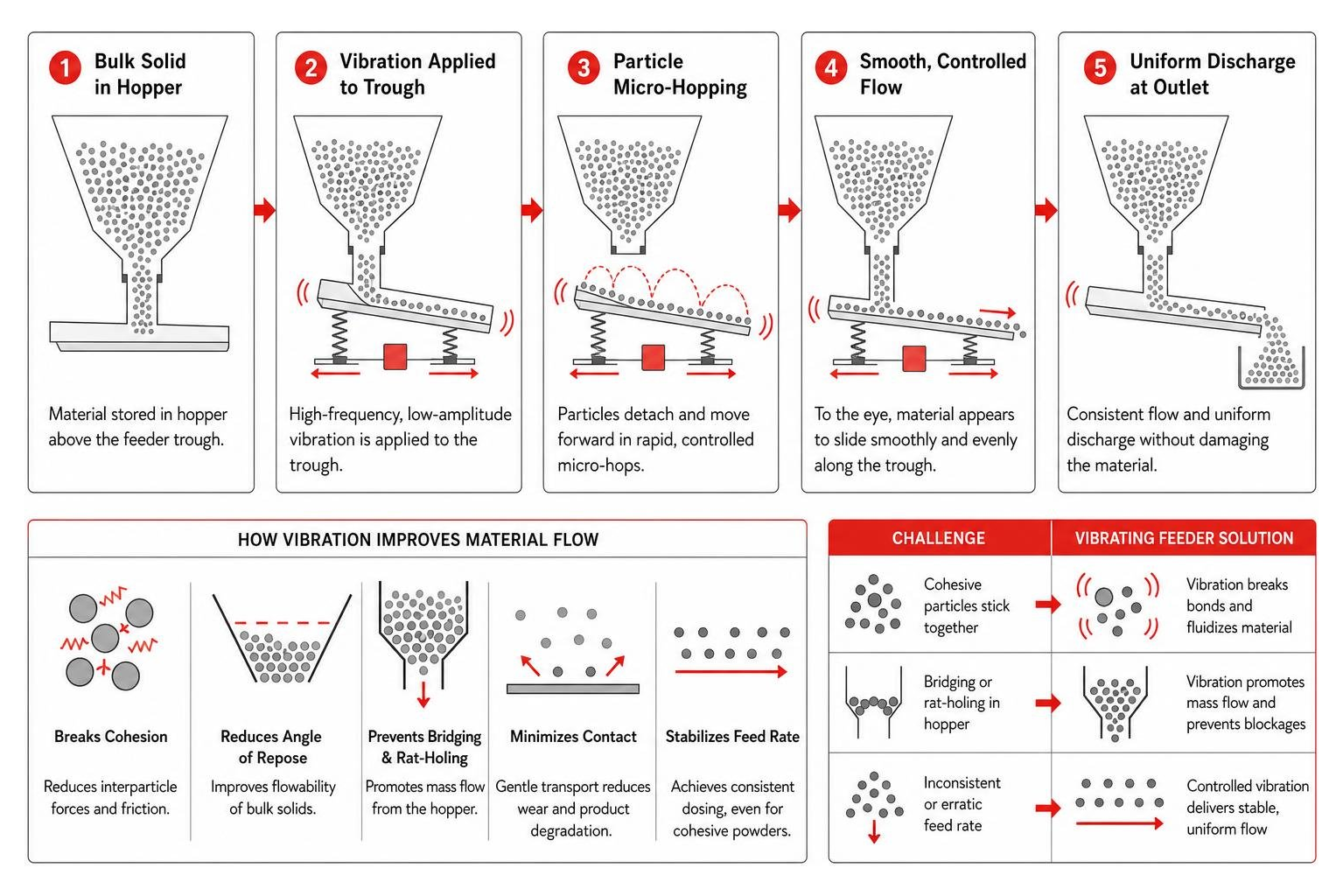
At its core, a pharmaceutical vibrating feeder operates on the physical principle of controlled acceleration. By combining high-frequency, low-amplitude oscillations with the natural force of gravity, the feeder moves bulk solids forward in a continuous series of microscopic hops or jumps. This micro-hop motion is so rapid and precise that, to the naked eye, the material appears to slide smoothly and evenly along the feeding trough.
This gentle transport mechanism is a major operational advantage over traditional mechanical feeding systems. Screw feeders, for example, rely on mechanical shear and rotational friction to push materials through a tube. This mechanical action can degrade fragile granules, chip finished tablets, or cause cohesive powders to compact, build up, and eventually bind the screw. A vibrating feeder eliminates these rotating parts in the product stream, ensuring a stable material flow and uniform discharge without subjecting the material to damaging mechanical forces.
Material Behavior and Cohesion Challenges
In pharmaceutical manufacturing, handling dry bulk solids is notoriously difficult due to the wide variation in physical properties. Active Pharmaceutical Ingredients (APIs) and excipients often consist of fine, highly cohesive particles. These materials exhibit poor flowability because van der Waals forces, electrostatic charges, and ambient moisture cause the particles to stick to one another and to equipment walls.
Applying targeted external vibration directly to the feeding trough breaks these interparticle bonds. This fluidizes the material, reduces the angle of repose, and prevents common flow obstructions like bridging or rat-holing in the feed hopper. Research into the micro-feeding and mixing of pharmaceutical solid dosage forms under external vibration shows that precise vibration parameters can stabilize feed rates even for highly cohesive powders, achieving consistent dosing at very low mass flows.
How Do Electromagnetic and Motor-Driven Drives Compare in Pharma Applications?
The drive system is the engine of the vibrating feeder, and selecting the right drive technology is critical to process reliability. Pharmaceutical applications typically utilize either electromagnetic drives or electromechanical motor drives, each offering distinct operational benefits depending on the process requirements.
- Electromagnetic Drives: These drives utilize an electromagnet and a spring system to generate high-frequency vibration. Because the vibration amplitude is controlled electronically by adjusting the voltage or current to the magnet, electromagnetic feeders offer 100% adjustability and instant start-stop capabilities. This makes them the industry standard for precise micro-dosing, loss-in-weight batching, and applications requiring immediate feed termination to prevent overfilling.
- Electromechanical Motor Drives: These systems utilize rotary electric vibrator motors with adjustable eccentric weights to generate vibration. Motor-driven feeders are highly efficient at delivering consistent, high-throughput vibration for bulk ingredient transfer and heavy-duty conveying. They are ideal for moving large volumes of raw materials from storage hoppers to downstream processing areas.
| Parameter | Electromagnetic Drives | Electromechanical Motor Drives |
|---|---|---|
| Feed Rate Control | Instantaneous, infinitely adjustable (0 to 100%) | Adjustable via Variable Frequency Drive (VFD) |
| Start / Stop Response | Immediate (milliseconds) | Gradual ramp-up and coast-down |
| Throughput Capacity | Best suited for low to medium rates, micro-dosing | Excellent for high-capacity bulk transfer |
| Maintenance | Minimal (no rotating parts or bearings to wear) | Periodic bearing lubrication and weight adjustment |
| Power Consumption | Extremely low (often under 50 Watts for small units) | Low to moderate depending on motor size |
For more details on drive configurations and mechanical designs, explore our technical overview of Vibrating Feeders.
How Do Vibrating Feeders Achieve High Dosing Accuracy?
Achieving strict dosage uniformity in pharmaceutical manufacturing requires highly accurate feeding systems. Vibrating feeders achieve this accuracy by maintaining a highly consistent material density and flow profile across the entire width of the feeding tray.
When integrated into a process, these systems can operate under two primary feeding principles:
- Volumetric Feeding: The feeder operates at a set vibration frequency and amplitude to discharge a consistent volume of material over time. This method relies on the material having a uniform bulk density.
- Gravimetric (Loss-in-Weight) Feeding: The entire vibratory feeder assembly is mounted on high-precision load cells. The control system continuously weighs the feeder and calculates the rate of weight loss. By comparing this actual feed rate against the desired setpoint, the controller automatically adjusts the vibration intensity in real time.
A primary challenge in gravimetric feeding is filtering out ambient process vibrations from the weight signal. Modern pharmaceutical vibratory feeders utilize advanced digital signal processing and specialized shock-absorbing suspension systems. These technologies isolate the weighing sensor from external building or machinery vibrations, allowing the controller to maintain stable material flow and predictable discharge rates. This level of control allows modern vibratory systems to achieve feeding accuracies averaging 35% better than traditional mechanical feeding technologies, supporting continuous-duty operation across long production runs.
What Design Features Ensure GMP Compliance and Sterile Operation?
In the pharmaceutical industry, equipment design is dictated by Current Good Manufacturing Practice (cGMP) regulations. Every component of a pharmaceutical vibrating feeder must be engineered to prevent product contamination, facilitate thorough cleaning, and allow for complete process validation.
To meet these strict sanitary requirements, all product contact surfaces are fabricated from 316L stainless steel. This material provides superior corrosion resistance against aggressive active ingredients, acidic or alkaline cleaning agents, and sanitizing chemicals.
Furthermore, the surface finish of the metal is highly controlled. Contact surfaces undergo mechanical grinding and electropolishing to achieve a mirror-like finish with a roughness average (Ra) of less than 0.2 μm. This ultra-smooth surface eliminates microscopic crevices, pits, and scratches where product residue, bacteria, or pathogens could collect. Non-contact parts are typically fabricated from 304 stainless steel and finished to a clean, smooth standard suitable for washdown environments.
To prevent dust generation and atmospheric contamination, pharmaceutical feeders utilize fully enclosed designs. Tubular troughs or pan troughs with tightly sealed, removable covers isolate the product from the surrounding cleanroom environment. These enclosures protect operators from exposure to potent APIs and prevent airborne dust from settling on the product.
How Do Quick-Release Clamps and CIP/SIP Systems Improve Changeover Times?
Frequent product changeovers are standard in pharmaceutical batch manufacturing. To minimize downtime and prevent cross-contamination, feeders must be designed for rapid, thorough cleaning.
Modern units incorporate quick-release tri-clamp connections and modular components that allow operators to disassemble the entire feeding trough, hopper, and cover without using tools. Once disassembled, these lightweight components can be taken to a wash station for Wash-Out-of-Place (WOP) cleaning.
For integrated production lines, feeders can be engineered for Clean-In-Place (CIP) or Sterilize-In-Place (SIP) protocols. These systems feature strategically placed spray nozzles within the enclosed trough to deliver washing cycles, purified water rinses, and sanitizing steam without requiring disassembly. The seamless, weld-free, and self-draining design of the trough ensures that no cleaning fluids pool inside the equipment. This highly cleanable design reduces cleaning validation times and ensures that active ingredient residues are easily kept below the strict 10 ppm limit required for multi-product facilities.
To learn more about sanitary equipment design and modular configurations, view our Equipment Overview.
What Explosion-Proof and Regulatory Standards Must These Feeders Meet?
Pharmaceutical vibrating feeders must comply with a stringent network of global regulatory frameworks and safety standards:
- FDA and EU GMP: All polymer seals, gaskets, and flexible sleeves in contact with the product must be fabricated from FDA-approved materials, such as pharmaceutical-grade silicone or PTFE, which do not leach chemicals into the product.
- 3-A Sanitary Standards and EHEDG: These standards guide the hygienic design of the equipment, ensuring that all welds are continuous, ground smooth, and free of pockets or sharp corners that could harbor bacteria.
- Explosion-Proof Certifications (ATEX / NEC): Many pharmaceutical processes involve flammable organic solvents (e.g., in tablet coating or API crystallization) or handle combustible organic dusts. For these hazardous locations, feeders are equipped with explosion-proof electromagnetic drives or intrinsically safe electromechanical motors certified for Class I or Class II, Division 1 and 2 environments.
- Control System Integration: Modern feeders feature smart control modules that integrate seamlessly with plant-wide PLC, DCS, or Manufacturing Execution Systems (MES). These controllers support 21 CFR Part 11 compliance by maintaining secure electronic batch records, audit trails, and calibration logs to ensure complete process traceability.
How Are Vibrating Feeders Applied in Pharmaceutical Manufacturing?
Vibrating feeders are utilized across both upstream bulk chemical processing and downstream solid dosage formulation. Their ability to handle materials gently while maintaining precise flow rates makes them indispensable at several critical stages of production.
How Do Feeders Optimize API Weighing, Granulation, and Coating Processes?
- API and Excipient Weighing: In the initial dispensing and batching stages, vibrating feeders provide the precise control needed to meter expensive active ingredients and bulk excipients into blending vessels. Their dual-speed feeding capability (fast bulk feed followed by a slow dribble feed) ensures batching accuracies within ±0.2% to ±0.3%.
- Continuous Granulation: Continuous wet and dry granulation lines require a steady, pulsation-free feed stream to maintain consistent granule size and moisture levels. Vibrating feeders deliver a uniform mass flow of blended powders directly to twin-screw granulators or roller compactors, preventing the surging or starving of downstream equipment.
- Tablet Coating: Spray-coating tablet cores requires them to be introduced into the coating drum at a controlled, uniform rate. A vibrating feeder with a wide, flat pan trough spreads the tablets evenly across its width, feeding them gently into the coater without causing edge chipping, capping, or surface abrasion.
- Packaging Lines: Upstream of bottle-filling or blister-packaging machines, vibrating feeders singulate, orient, and feed tablets, capsules, or small medical components. Their gentle handling ensures that no broken or damaged product enters the final packaging, reducing reject rates and protecting product quality.
For a deeper look into how vibratory technology optimizes material handling across diverse industries, read our whitepaper on Optimizing Industrial Processes with Efficient Vibratory Feeders.
How Can Custom Engineering Solve Difficult Pharmaceutical Material Handling Challenges?
Every pharmaceutical powder, granule, and tablet behaves differently under vibration. A feeder design that works perfectly for a free-flowing excipient like microcrystalline cellulose may fail completely when handling a cohesive, hygroscopic herbal extract or a highly fragile, uncoated tablet. Generic, catalog-selected equipment often fails to account for these subtle material variations, leading to production bottlenecks, material buildup, or product damage.
This is where custom engineering and rigorous application testing become essential. Successfully handling difficult pharmaceutical materials requires a deep understanding of material behavior, particle size distribution, moisture content, and cohesive properties.
At Carrier Vibrating Equipment, we do not believe in one-size-fits-all machinery. We are custom engineering specialists and process reliability experts. We design and manufacture vibrating conveyors, feeders, bulk material dryers, coolers, and integrated processing systems tailored specifically to the unique physical properties of your material and the exact constraints of your cleanroom layout.
Through extensive application testing in our state-of-the-art laboratory, we analyze how your specific material responds to different vibration frequencies, amplitudes, and trough geometries. This testing ensures that your final system is engineered to deliver stable material flow, uniform moisture and temperature control, and long-term continuous-duty operation.
Carrier Vibrating Equipment can evaluate your material and design a system engineered for your specific process. Contact our team to start a technical review.