
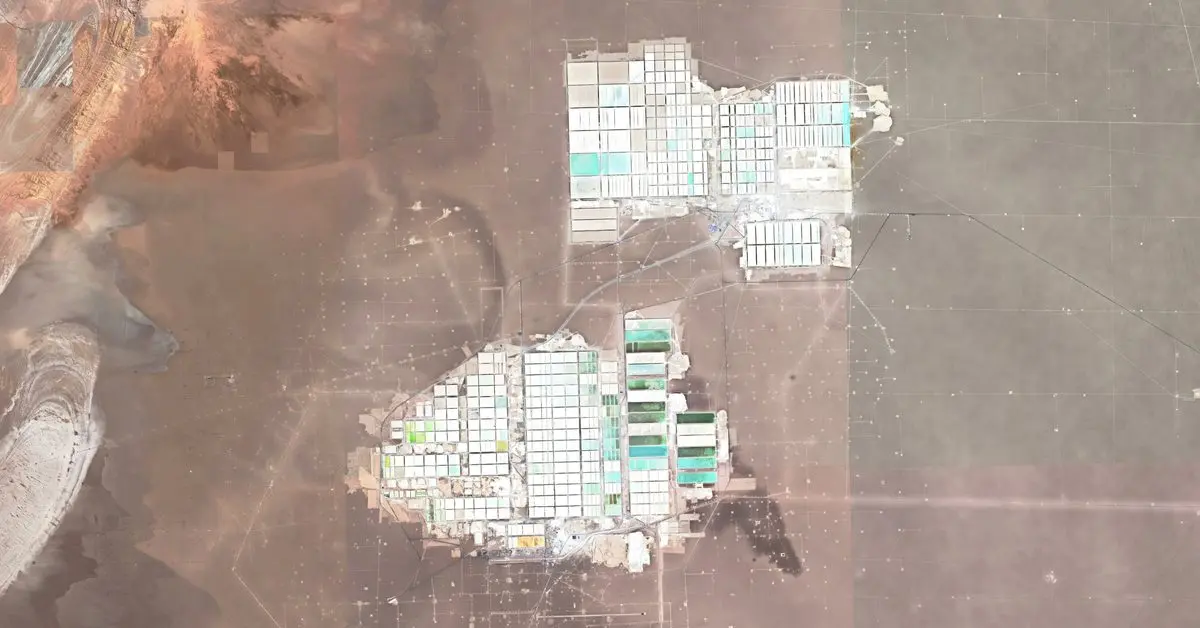
Why Lithium Brine Processing Matters for the Battery Supply Chain
Lithium brine processing is the method of extracting lithium from underground salt-rich water (brines) found in salt flats, geothermal reservoirs, and oilfield produced water. Here’s how it works:
- Brine is pumped from underground reservoirs to the surface
- Lithium is concentrated through evaporation ponds (traditional) or direct extraction methods (modern)
- Impurities are removed through chemical precipitation, adsorption, or membrane filtration
- Lithium carbonate or hydroxide is crystallized and dried to battery-grade purity (≥99.5%)
- Final material is processed through thermal drying and cooling to meet strict moisture and particle specifications
More than half of the world’s lithium comes from brines in the Lithium Triangle (Argentina, Bolivia, and Chile). Traditional evaporation pond methods can take 18 months and use 350 to 600 square meters of land per ton of lithium carbonate.
Newer Direct Lithium Extraction (DLE) technologies reduce this timeline to days or weeks and require only 16 square meters per ton—but they introduce new thermal processing demands.
Battery-grade lithium must meet strict purity standards. Even small amounts of contaminants like sodium, calcium, or magnesium can reduce battery performance or create safety risks. That’s why precise material handling, moisture control, and thermal processing are critical in the final stages of lithium brine processing.
I’m Mike Eaton, Director of Marketing for Carrier Process Equipment Group, where I work with engineering teams to translate complex industrial processes—including lithium brine processing—into reliable, scalable equipment solutions. Over 25 years in B2B industrial marketing has shown me that the difference between efficient and inefficient production often comes down to how well bulk materials are handled, dried, and cooled.
Global Sources and Technical Challenges of Brine Extraction
The global search for lithium has intensified as the electric vehicle (EV) market undergoes a rapid revolution. According to USGS lithium production data, the primary commercial sources are underground brine reservoirs, often referred to as salars. While hard rock mining of minerals like spodumene remains significant, lithium brine processing is generally a less expensive method. It avoids the high energy costs associated with mining, grinding, and the high-temperature calcination (roasting) required for ores.
Geographically, the “Lithium Triangle” of Argentina, Bolivia, and Chile dominates the landscape, but significant resources also exist in China and the Western USA. Beyond traditional salt lakes, the industry is looking toward unconventional sources such as geothermal brines and “produced water” from oilfield operations. At Carrier Vibrating Equipment, we see these diverse sources as unique engineering challenges, particularly when it comes to the final thermal processing of the extracted minerals.
Brine Composition and Mg/Li Ratios
The technical feasibility of a lithium project often hinges on the chemical “neighborhood” the lithium lives in. Most brines contain a complex mix of ions, including sodium (Na+), potassium (K+), calcium (Ca2+), and magnesium (Mg2+). The most significant hurdle is the Magnesium-to-Lithium (Mg/Li) ratio.
Magnesium and lithium have similar ionic radii, making them difficult to separate. In many Asian salt lakes, this ratio can be as high as 1,000:1, whereas South American brines typically hover around 10:1. If the lithium-ion concentration is above 300 mg/L (approximately 0.0025 lb/gal), the brine is generally considered commercially viable for industrial extraction. However, high magnesium levels require intensive chemical precipitation or advanced ion selectivity technologies to prevent impurities from entering the final battery-grade product.
Traditional Evaporation vs. Modern Lithium Brine Processing
The “old school” method of lithium recovery is straightforward but requires immense patience and a lot of sunshine. In this process, salt-rich water is pumped to the surface and into a massive network of evaporation ponds.
Over a period of up to 18 months, solar heat slowly evaporates the water. As the liquid becomes more concentrated, different salts precipitate out at different stages. Once the brine reaches a lithium concentration of approximately 6%, it is pumped into a processing plant for conversion into lithium carbonate.
While this method is cost-effective due to its reliance on solar energy, it is highly weather-dependent. Unexpected rainfall can dilute the ponds and reset the clock on the 18-month cycle. Furthermore, scientific research on lithium extraction indicates that the overall lithium recovery rate for traditional precipitation is frequently below 50%.
Environmental Impacts of Traditional Methods
The environmental footprint of evaporation ponds is a growing concern for the industry. While these projects have lower carbon emissions than hard rock mining (which releases about 37 tons of CO2 per ton of lithium), they are extremely land-intensive. A traditional project may use 3,700 to 6,400 sq ft of land per ton of lithium carbonate equivalent.
Furthermore, water scarcity is a critical issue. In arid regions like the Andes, pumping vast amounts of brine can lower the water table and disrupt local ecosystems. A 2021 study found that lithium production from brine can create about 11 tons of CO2 per ton of lithium, largely due to the reagents and auxiliary power required for purification. These environmental trade-offs are driving the industry toward more sustainable, integrated systems.
Advanced Technologies: DLE and Chemical Selectivity
To address the inefficiencies of evaporation, the industry is pivoting toward Direct Lithium Extraction (DLE). DLE acts like a chemical “filter,” using specialized materials to grab lithium ions while letting other minerals pass through. This technology is a game-changer because it can reduce processing time from months to hours and significantly reduce the land footprint to just 16 sq ft per ton.
According to research on the environmental costs of lithium extraction, DLE also offers the potential to return nearly all the water back to the underground reservoir after extraction, preserving local water levels.
Adsorption and Ion Exchange in Lithium Brine Processing
The heart of DLE is often an adsorption bed. The raw brine is first filtered through 20-40 micron cartridges to remove silt and undissolved salts. It then passes through adsorption beds filled with specialized resins or lithium-ion sieves (often manganese or titanium-based). These resins are engineered to selectively adsorb lithium while ignoring contaminants like calcium and magnesium.
Once the adsorption bed is saturated, it is taken offline. Deionized water is used to elute (wash) the lithium from the resin, creating a concentrated lithium stream of approximately 2,500 ppm. This stream is then further concentrated and purified using reverse osmosis (RO) or mechanical vapor recompression (MVR) before final crystallization.
Thermal Requirements for Lithium Brine Processing
Whether using traditional or DLE methods, thermal management is vital. Brines often need to be heated to specific temperatures to optimize chemical reactions or to facilitate the elution process. In geothermal applications, the brine arrives at the surface already hot, providing a unique opportunity to combine power generation with mineral recovery.
Scientific research on geothermal brine recovery highlights that maintaining stable material flow and uniform temperatures is essential to prevent scaling—where minerals like silica precipitate and clog the equipment. Carrier Vibrating Equipment understands that these high-temperature, high-salinity environments require custom-engineered solutions that prioritize abrasion resistance and continuous-duty operation.
Refining to Battery-Grade: Industrial Drying and Cooling
The final step in lithium brine processing is the conversion of the concentrated brine into a solid, shippable product: either lithium carbonate or lithium hydroxide. This is where the engineering expertise of Carrier Vibrating Equipment becomes critical.
After the lithium is precipitated and filtered, the resulting “cake” must be dried and cooled. This isn’t just about removing water; it’s about protecting the product’s integrity. For lithium-ion batteries, the material must be ultra-pure (99.5%+) and have a very specific moisture content and particle size distribution.
We engineer vibrating fluid bed dryers and coolers specifically for these demanding applications. Unlike static dryers, a vibrating fluid bed uses a combination of controlled airflow and natural-frequency vibration to “fluidize” the lithium crystals. This ensures:
- Uniform Moisture and Temperature: Every particle is exposed to the same drying conditions, preventing “wet spots” or over-dried material.
- Particle Integrity: The gentle vibration moves the material without the mechanical agitation that can break fragile crystals, maintaining the required particle size.
- Energy Efficiency: Fluid bed technology provides superior heat transfer rates, reducing the total energy required for the process.
- Abrasion Resistance: Lithium minerals can be abrasive. Our systems are custom-engineered with high-grade alloys to ensure long equipment life and low downtime.
Purity Standards for Battery Minerals
The requirements for battery-grade materials are unforgiving. Contaminants like sodium must be kept below 0.05 wt.%, and calcium below 0.040 wt.%. Even the drying air must be filtered to prevent any ambient dust from contaminating the lithium.
At our facilities in Louisville, KY, Nivelles, Belgium, and Shanghai, China, we perform extensive application testing to ensure our systems meet these rigorous standards. By simulating real-world process conditions in our lab, we can guarantee predictable process performance before the equipment ever reaches the site.
Frequently Asked Questions about Lithium Extraction
What is the difference between DLE and evaporation ponds?
Evaporation ponds rely on solar energy and time (18 months) to concentrate lithium through water loss. DLE uses chemical adsorbents, membranes, or ion exchange to extract lithium directly from the brine in a matter of hours or days. DLE is more expensive in terms of capital equipment but offers higher recovery rates and a much smaller environmental footprint.
How does brine composition affect processing costs?
The higher the Mg/Li ratio, the more expensive the processing. High magnesium levels require more chemical reagents (like hydrated lime) and more complex filtration stages to achieve the necessary purity. Brines with high levels of boron or sulfates also require additional liquid-liquid extraction or ion-exchange steps.
Why is drying critical for battery-grade lithium?
Moisture is the enemy of lithium-ion batteries. Residual water in the lithium carbonate or hydroxide can lead to side reactions within the battery cell, reducing its lifespan and increasing the risk of thermal runaway (fire). Precise thermal processing ensures the material is bone-dry while maintaining the specific crystal structure needed for battery cathode manufacturing.
Conclusion
The transition to a clean energy future depends on a reliable, efficient, and sustainable supply of lithium. From the vast salars of the Lithium Triangle to the advanced DLE plants of tomorrow, lithium brine processing is the engine driving this change. However, extracting the mineral is only half the battle; refining it into a high-purity, battery-grade material requires world-class engineering and precise thermal control.
Carrier Vibrating Equipment engineers and builds vibrating conveyors, feeders, dryers, coolers, and integrated processing systems for the most demanding bulk materials and thermal applications. We don’t just supply machines; we provide process reliability and high-performance systems custom to your specific brine chemistry and throughput needs.
Carrier Vibrating Equipment can evaluate your material and design a system engineered for your specific process. Contact our team to start a technical review and learn more about how we can optimize your battery mineral production.