
Why Bulk Material Handling Solutions Are Critical to Industrial Operations
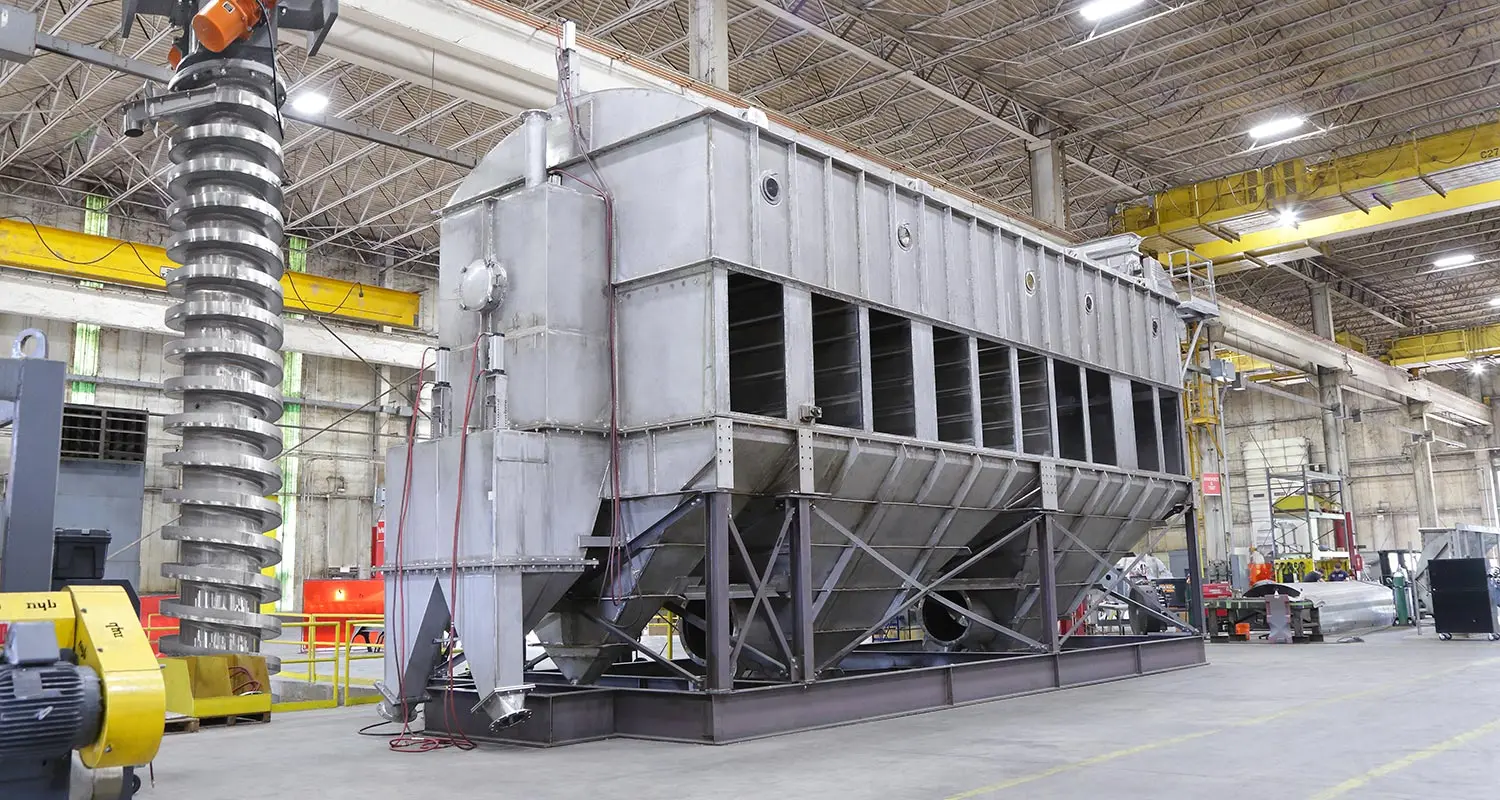
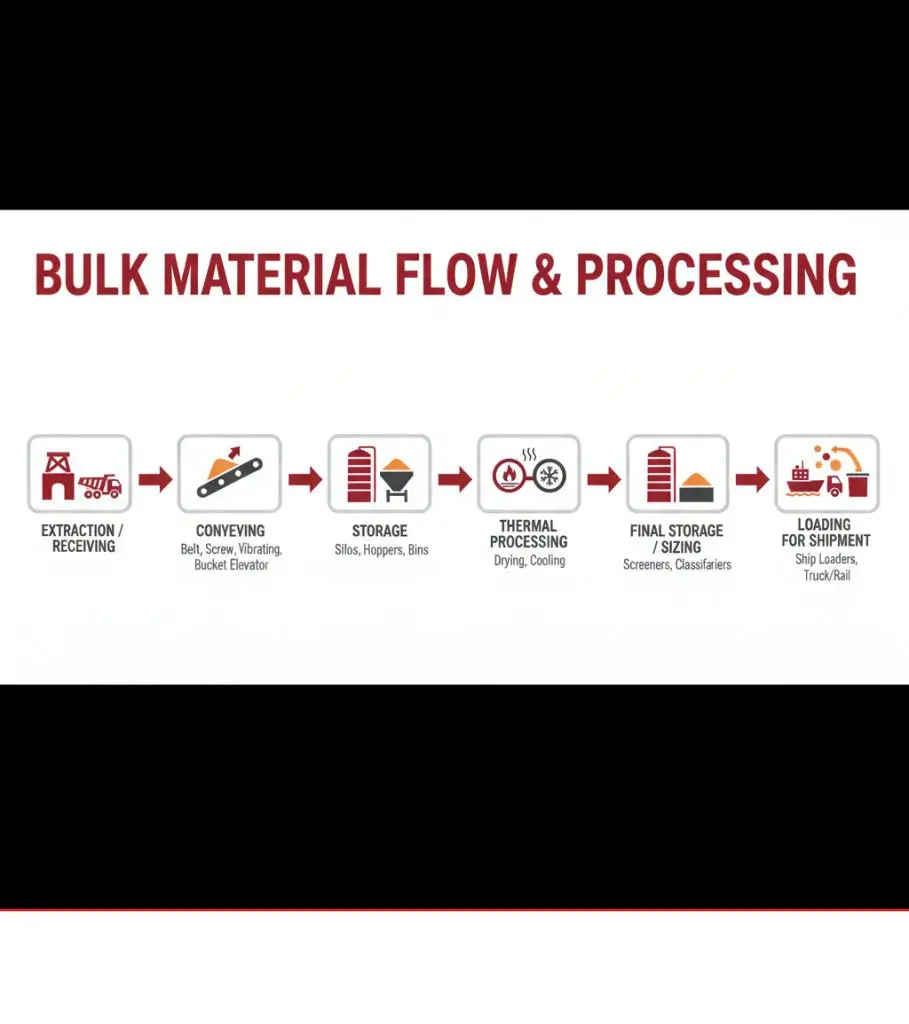
Bulk material handling solutions are the integrated systems and equipment that move, store, process, and transport loose materials like powders, granules, and aggregates. These solutions range from individual vibrating conveyors to complete processing lines that include thermal treatment, screening, and storage.
Key Components of Bulk Material Handling Solutions:
- Conveying & Elevating Systems – Equipment to move materials horizontally or vertically, such as vibrating conveyors and spiral elevators.
- Feeding & Screening Equipment – Vibrating feeders for controlled flow and screeners for size separation.
- Storage & Discharge Solutions – Silos and hoppers integrated with vibrating bin dischargers to ensure consistent material flow.
- Thermal Processing Equipment – Advanced industrial dryers, coolers, and heat exchangers.
- Automation & Control Systems – Integrated controls for monitoring, automation, and safety.
The global bulk material handling equipment market was valued at USD 16.1 billion in 2022 and is projected to reach USD 23.5 billion by 2030, growing at a CAGR of 4.9%. This growth reflects a fundamental shift in how industries approach material handling.
Modern bulk material handling is about creating integrated systems that can convey, heat, cool, dry, and screen materials while operating reliably in harsh conditions. Mining operations must process more ore, power plants handle alternative fuels, and chemical manufacturers need precise control over material properties.
The challenge is that real-world materials are often sticky, abrasive, and unpredictable. Facilities operate 24/7 in dusty, high-temperature environments where conventional equipment fails, and downtime can cost thousands per hour.
This guide explores how advanced bulk material-handling and drying solutions address these problems, focusing on thermal processing and integrated systems that transform materials into finished products.
The Core Challenge: Moving and Processing Bulk Materials Efficiently
Every industrial operation faces the same fundamental challenge: how do you keep materials flowing smoothly when they clump in storage bins, wear through components, and generate clouds of dust? When something goes wrong in these harsh environments, the entire operation can grind to a halt.
When Your Environment Works Against You
Bulk material handling solutions operate in some of the toughest conditions imaginable: mining sites with extreme temperature swings, chemical plants with corrosive substances, and power plants where abrasive materials grind against moving parts around the clock.
These environments demand equipment that can take a beating and keep working. You need components that won’t corrode, materials strong enough to handle abrasion, and systems that remain stable when covered in dust or operating in extreme heat.
The equipment that survives these conditions is built specifically for harsh, dirty working conditions where conventional machinery fails. Reliability isn’t just a feature—it’s the difference between running production and watching your equipment deteriorate.
Materials That Refuse to Cooperate
If all bulk materials behaved the same way, handling them would be simple. But they don’t.
Material properties vary dramatically. Fine powders flow differently from coarse aggregates, and dense materials require more energy to move. Moisture content can turn a free-flowing powder into a sticky, clumping nightmare that bridges across discharge openings and stops your entire process.
Flowability issues appear when you least expect them. Materials can arch across bin openings, form ratholes in silos, or segregate during handling, compromising product consistency. These problems don’t just slow you down—they make it impossible to maintain quality. That’s why keeping silos flowing with vibrating bin dischargers has become essential for operations that can’t afford material flow interruptions.
The Real Cost of Equipment Failures
When your handling systems fail, the costs add up fast.
Downtime is the most immediate cost. Every idle hour means lost production you can’t recover. Maintenance costs drain budgets when equipment isn’t built for your specific materials, as abrasive and corrosive substances wear out standard components prematurely.
Safety hazards emerge from poorly engineered systems. Dust can accumulate and become an explosion risk, materials can spill from overloaded conveyors, and unexpected equipment failures put workers at risk. For example, conveyor belt fires create a safety hazard in industry that can shut down facilities and endanger lives.
These are fundamental challenges that require equipment designed specifically for your materials, environment, and process goals. Generic solutions don’t cut it when your operation faces this level of complexity
Essential Equipment in Modern Bulk Material Handling and Drying Solutions
Moving and processing bulk materials requires the right tools for the job. A well-designed system is like a high-performing team, where each piece of equipment plays a specific role to achieve a remarkable result.
Conveying and Elevating
Every bulk material handling solution starts with movement. Vibrating Conveyors are the workhorses of material transport, using controlled vibrations to gently move materials. They excel at handling hot, abrasive, fragile, or sticky materials that would destroy other systems. They can also process materials while conveying, performing tasks like drying or cooling simultaneously.
For vertical movement in a tight space, Vibrating Spiral Elevators are invaluable. These compact units lift materials while often performing additional processing, packing tremendous capability into a small footprint.
Feeding and Screening
Before processing, materials often need to be metered and sorted. Vibrating Feeders ensure a steady, controlled flow of material into downstream equipment, preventing surges and ensuring consistency. Industrial Screening Equipment then separates materials by size, removing oversized particles or fines to meet exact product specifications and ensure quality control.
Storage and Discharge
Storing materials is one thing; getting them out reliably is another. While silos and hoppers provide bulk storage, poor design can lead to flow problems like arching or ratholing.
Vibrating Bin Discharger Equipment solves this by attaching to silos and hoppers to ensure consistent, uninterrupted material flow. They are critical for materials prone to compaction or bridging, preventing blockages that cause production delays. As explored in Keeping Silos Flowing: Vibrating Bin Dischargers, they can be the key to a smoothly running facility.
A Deeper Dive: Thermal Processing and Drying Systems
This is where materials are truly transformed. Removing moisture or changing temperature can turn a raw material into a finished product.
Vibrating Fluid Bed Dryers suspend material in a hot air stream while vibrating the bed, ensuring uniform drying and efficient heat transfer. This gentle approach is ideal for sensitive materials, allowing precise control over temperature and residence time. For background, see the fundamentals of fluidized bed operation.
Flash Dryers are used for materials with surface moisture or those needing rapid drying. A high-velocity hot gas stream quickly removes moisture as material is dispersed through the system. For a concise overview, see flash drying.
The science behind these systems is complex. Understanding Thermal Processing Equipment: How It Works reveals how heat and mass transfer are optimized to achieve the desired result without damaging the product.
Cooling systems are just as critical. Fluid Bed Coolers use cool air to efficiently reduce the temperature of the material. For indirect temperature control, Bulk Material Heat Exchangers provide precise thermal management without contamination concerns.
Applications for these thermal systems are vast. Sand Drying Equipment handles unique granular challenges, while Drying Pigments for Paint requires precision for color consistency. Even Limestone Drying transforms raw rock into a vital industrial material through effective thermal processing.
Innovations Driving Performance and Reliability
Bulk material handling solutions are evolving rapidly, driven by breakthroughs in materials science and digital technology that make systems tougher, smarter, and more efficient.
Advanced Materials
Equipment faces a daily battle against harsh conditions, which is why the materials used to build it are so important. Modern systems increasingly rely on corrosion-free components and high-strength alloys that outlast traditional materials. Specialized engineered components resist dirt, chemicals, and high temperatures while maintaining stability under extreme stress. They thrive in abrasive environments and withstand large temperature fluctuations.
The result is equipment that runs longer between maintenance cycles and costs less to operate over its lifetime. When a system must run 24/7 in a dusty, corrosive, or high-temperature environment, these resilient components are essential.
Automation and Smart Systems
If advanced materials make equipment tougher, digital technology makes it smarter. The Industrial Internet of Things (IIoT) has transformed how we monitor and maintain bulk material handling solutions.
IIoT sensors embedded in modern systems continuously collect data on temperature, vibration, flow rates, and motor performance. This information flows to remote monitoring systems, allowing operators to track performance in real-time from a control room or off-site.
The real breakthrough is predictive maintenance. Instead of waiting for a breakdown, smart systems analyze data trends to predict failures before they happen. A worn bearing can be flagged for replacement during the next scheduled maintenance window, not in the middle of a production run.
Our Vibratrac system embodies this approach, providing the insights needed to keep equipment running smoothly and avoid costly unplanned downtime.
System-Level Innovations
The most exciting innovations involve how entire systems work together. Integrated conveying and drying systems combine multiple functions into a single solution, such as a vibrating conveyor that simultaneously dries or cools material. This integration reduces a facility’s footprint, cuts energy consumption, and simplifies operations.
This integration extends to larger automated systems, like stockyards, where vibratory equipment plays a key role in managing material storage and retrieval with precision. These system-level advances are making facilities more efficient across many industry applications.
The Role of Customization in Advanced Bulk Material Handling and Drying Solutions
No two materials behave identically, and no two facilities face the same challenges. That’s why customization is fundamental to creating bulk material handling solutions that truly work.
Custom engineering means we start with your specific needs. Our engineers design solutions for unique material properties and difficult plant layouts. Learn more about our approach through Vibrating Custom Engineering.
Before any design, we conduct material testing in our Lab Testing facilities in Louisville, KY, and Nivelles, Belgium. We analyze particle characteristics, flow behavior, and abrasiveness to understand exactly what your material needs.
Process simulation then uses this data to model how your material will flow through a proposed system, allowing us to optimize the design before construction begins.
Different industries demand different approaches. The sanitation requirements in Food & Dairy are worlds apart from the heavy-duty demands of Mining. We design for these specific realities.
We also accept modular design principles, giving you the scalability to expand or reconfigure your system as your business grows. It’s customization that adapts with you.
Key Benefits: Optimizing Your Operations
Investing in modern, custom-engineered bulk material handling solutions is more than an equipment purchase—it’s a strategic upgrade that benefits your entire operation.
Cost Reduction
Modern systems are highly efficient at trimming expenses. Energy consumption drops significantly with equipment designed for your specific material, eliminating wasted power. Our advanced drying processes, for example, are engineered to Save Money Drying Process by using heat precisely and effectively.
Maintenance costs decrease when you run robust equipment built from advanced materials and monitored with predictive technology. Components last longer, and repairs are scheduled during planned downtime, making your budget more predictable.
Perhaps the most valuable benefit is minimized downtime. Reliable equipment keeps your production schedules on track, keeps customers happy, and maintains healthy profitability.
Improved Efficiency
Efficiency means getting more value from every resource. Higher throughput is an immediate benefit, as optimized equipment allows you to process more volume in the same amount of time. This increases your facility’s capacity without expanding its footprint.
This is paired with better product quality. Consistent feeding, precise thermal processing, and effective screening ensure your final product meets specifications every time, reducing waste and rework. These improvements deliver an impressive Return on Investment: Manufacturing Equipment.
Optimized space utilization is another game-changer. Integrated systems that combine conveying and processing, like vibrating spiral elevators, pack more capability into a compact footprint.
Improved Safety and Sustainability
Modern bulk material handling solutions create better workplaces and lighter environmental footprints. Reduced dust emissions from enclosed systems protect your workers and the community. A lower carbon footprint results from energy-efficient equipment and optimized processes that reduce waste, as seen in applications like How Fly Ash Machinery is Paving the Way for Sustainable Business Practices.
Finally, safer working environments are a natural outcome of well-designed systems. Automation reduces worker exposure to hazards, and predictive maintenance prevents catastrophic failures.
How to Choose the Right Bulk Material Handling and Drying Solutions
Choosing the right bulk material handling solutions is a critical decision that will impact your facility’s performance for years.
First, understand your material. Analyze its properties: particle size, flow characteristics, abrasiveness, moisture content, temperature sensitivity, density, and chemical composition. Each factor shapes the ideal equipment design.
Next, define your process goals. What are your throughput requirements? Does your material need heating or cooling? What are the final product specifications? Also, consider your space constraints, budget, and operational environment (ambient temperature, humidity, etc.).
Then, evaluate potential vendors. Look for partners with proven engineering expertise and a track record with materials like yours. Testing capabilities are non-negotiable; a serious vendor must have a lab to test your actual material. Inquire about their experience in your industry and their commitment to after-sale support. Reliable After Sale service is crucial for long-term success.
Key questions to ask potential equipment providers:
- How do you ensure your equipment is designed for my material’s unique properties?
- What kind of material testing do you conduct?
- Can you provide examples of similar projects you’ve completed?
- What are your standard lead times for custom-engineered solutions?
- What level of automation and control can your systems offer?
- What is your approach to after-sales support and long-term maintenance?
Frequently Asked Questions about Bulk Material Handling and Drying
You’ve got questions about bulk material handling solutions, and we’ve got answers based on decades of engineering experience.
How do you determine the right type of conveyor or dryer for a specific material?
It comes down to a deep understanding of your material. We analyze its properties: is it sticky, abrasive, fragile, or heat-sensitive? These characteristics guide our recommendations.
For conveying, we consider particle size, density, and chemical composition. Abrasive materials may require a heavy-duty Vibrating Conveyor with wear-resistant liners, while sticky materials benefit from the self-cleaning action of vibrating equipment. Temperature requirements and the conveying distance also help determine the ideal solution, which could be a single unit or a space-saving Vibrating Spiral Elevator.
For drying, we examine the initial vs. desired moisture content and the product’s heat sensitivity. This helps us choose between technologies like flash dryers for rapid surface moisture removal or Vibrating Fluid Bed Dryers for gentle, precise drying. Finally, your required throughput dictates the equipment’s size and capacity.
What is the importance of material testing before designing a system?
Material testing is paramount. It is the foundation of successful bulk material handling solutions. Without it, any design is based on guesswork, which is expensive in industrial operations.
Testing reveals your material’s unique flow characteristics, bulk density, abrasiveness, and thermal properties. This data allows us to engineer equipment that prevents flow problems like arching and ratholing before they can cause production stoppages. Our Lab Testing process is designed to identify these issues upfront.
Testing also optimizes efficiency by determining the most effective heat transfer rates, vibration frequencies, and screen sizes. This leads to lower energy consumption and higher throughput. Most importantly, it avoids costly post-installation modifications, saving you time and money. Our White Paper: CPEG Test Lab details this comprehensive process.
How can automation improve bulk material handling and drying operations?
Automation transforms bulk material handling solutions from labor-intensive to highly efficient and streamlined.
First, automation increases throughput by operating continuously at optimal speeds without fatigue or breaks. It also reduces labor costs by freeing personnel for higher-value tasks like process improvement and quality control.
Safety is significantly improved by removing operators from hazardous environments, such as dusty or high-temperature zones. The real-time data from integrated sensors provides invaluable insights for process optimization, enabling on-the-fly adjustments.
Finally, automation enables predictive maintenance. Constant monitoring with systems like Vibratrac identifies potential equipment failures early. This allows for scheduled maintenance, minimizing unplanned downtime and extending the life of your machinery.
Conclusion
The future of bulk material handling solutions is here, built on the pillars of efficiency, sustainability, and smart technology. Modern systems are designed to overcome the core challenges of handling difficult materials through custom engineering and cutting-edge innovation.
The real magic happens when you partner with experts who genuinely understand your world. At Carrier Vibrating Equipment, we don’t just manufacture equipment—we solve problems. Our engineering teams in Louisville, KY, and Nivelles, Belgium, have built a reputation on creating individually engineered solutions that work reliably in the toughest conditions imaginable.
Your materials have their own personality and challenges. Whether your sand won’t dry evenly, your chemical powders bridge in storage, or your aggregates wear through components, we are ready to design a solution.
The investment you make in the right bulk material handling solutions pays dividends in lower energy bills, fewer emergency repairs, safer working conditions, and consistent product quality. That’s the kind of return on investment that strengthens your bottom line.
Don’t settle for equipment that’s “close enough.” Your operation deserves solutions designed specifically for your materials, processes, and goals. Explore our custom solutions for the chemicals industry to see how we can solve your handling and drying challenges.
Let’s work together to keep your materials flowing, your processes running, and your operation thriving.