
Understanding the Sludge Drying Challenge
The sludge drying process is a thermal treatment that removes water from wastewater sludge via evaporation. Applying heat reduces moisture content from a typical 75-85% to just 5-15%, achieving a 75-90% volume reduction. This transforms heavy, wet waste into a dry, stable, and, if required, pathogen-free product.
Industrial and municipal facilities generate millions of tons of sludge annually, creating a significant disposal challenge. The primary problem is cost: wet sludge is mostly water, making it heavy, difficult to handle, and expensive to transport.
It’s crucial to distinguish drying from mechanical dewatering. While dewatering uses physical pressure to reach 25-35% dry solids, thermal drying uses heat to evaporate moisture, achieving 90-95% dry solids. It is not uncommon to have both mechanical dewatering followed by a heat-applied dryer to minimize moisture and energy costs.
This dramatic volume reduction directly lowers hauling and landfill fees. More importantly, it turns a disposal problem into a resource recovery opportunity. Dried sludge can be converted into valuable products like Class A biosolids for agriculture, fuel for energy recovery, or feedstock for cement kilns.
The “Why” and “How”: Core Principles of the Sludge Drying Process
Understanding why facilities invest in the sludge drying process and how it works is key to developing a smart waste management strategy.
Primary Reasons for Drying Sludge
The most immediate benefit is a 75-90% reduction in sludge volume. This drastically cuts hauling costs, fuel consumption, and disposal fees. Beyond logistics, the high temperatures used in thermal drying can eliminate pathogens and reduce odors, changing a biohazard into a stabilized, sanitized product.
For many municipalities, this process is essential to producing Class A biosolids that meet strict EPA standards for safe land application. Furthermore, removing water concentrates the organic content, increasing the sludge’s calorific value. This turns waste into a potential fuel for incineration or co-firing in cement kilns, creating an energy opportunity from a disposal problem. Effective drying changes a liability into an asset. For more insights, explore our section on Waste Recycling.
Understanding Heat Transfer in Thermal Drying
Thermal drying relies on heat transfer to give water molecules enough energy to evaporate. This occurs through three mechanisms:
- Conduction: Heat transfers through direct contact with a hot surface, like a heated paddle or wall.
- Convection: Hot air or gas circulates through the sludge, transferring heat and carrying away vapor.
- Radiation: Heat is transferred via electromagnetic waves, playing a smaller role in most bulk-material dryers.
Dryers use either direct heating, in which hot gases contact the sludge, or indirect heating, in which a medium such as steam heats a surface that contacts the sludge. Most industrial systems use a combination of methods to optimize efficiency. For a deeper dive, see our guide on Understanding Thermal Processing Equipment: How It Works.
Key Sludge Characteristics That Influence Drying
Not all sludge is the same, and its properties dictate the best drying technology and energy requirements.
- Moisture Content: Sludge enters at 75-85% moisture. Free water evaporates easily, but bound water (chemically or physically attached to solids) requires more energy to remove.
- Particle Size: Smaller, uniform particles dry faster and more evenly.
- Organic vs. Inorganic Content: This affects calorific value and drying behavior. High organic content can increase stickiness.
- Chemical Composition: The presence of chemicals can impact drying rates, cause corrosion, or limit end-use options for the dried product.
- Stickiness and Agglomeration: Some sludges become pasty or form clumps during drying, which can stick to equipment and hinder performance.
We strongly recommend thorough Lab Testing of your sludge to identify its unique properties and ensure the selected drying system will perform as expected.
A Guide to Sludge Drying Technologies and Equipment
When you’re evaluating options for your sludge drying process, you’ll quickly find there’s no one-size-fits-all solution. The technology that works brilliantly for a municipal wastewater plant in Louisville might not be ideal for an industrial facility in Shanghai. That’s why we focus on engineering robust, custom solutions custom to your specific needs.
Let’s walk through the main technologies available and help you understand which might be the best fit for your operation.
Convective (Direct) Drying Systems
Convective dryers work through direct contact between hot air or combustion gases and your sludge. The hot gas transfers heat to the material, evaporates moisture, and carries the vapor away. These systems are among the most common types of thermal dryers you’ll find in sewage sludge applications.
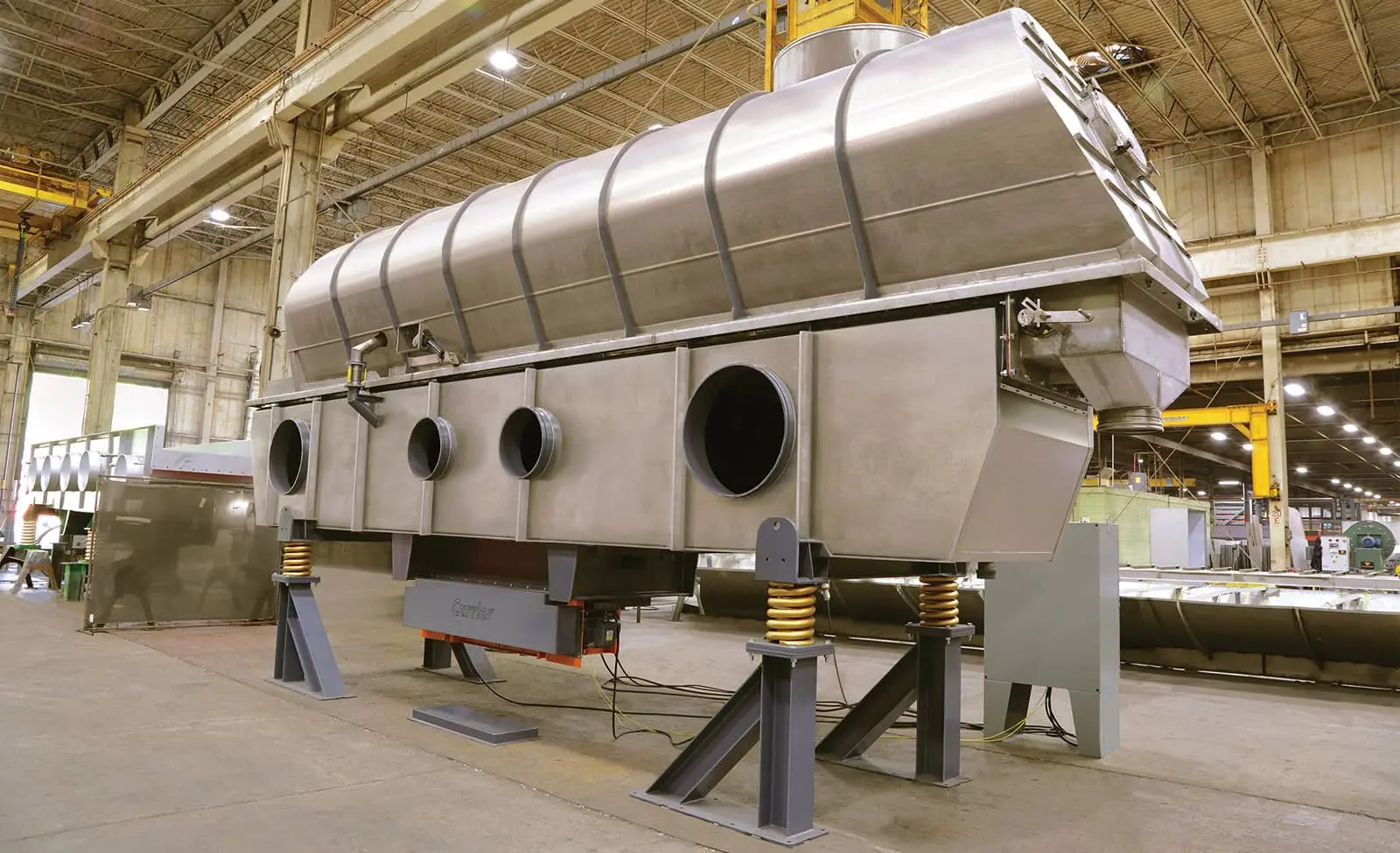
- Vibrating Fluid Bed Dryers blow hot air through a bed of material that conveys on an engineered perforated plate, causing sludge particles to fluidize and behave like a boiling liquid. This ensures excellent air-to-particle contact for efficient, uniform drying. The vibratory motion conveys and mixes the material and prevents clumping, making it ideal for granular or pelletized sludge.
- Flash Dryers achieve rapid drying by introducing fine, moist material into a high-velocity stream of hot gas. The intense contact and large surface area allow for nearly instantaneous evaporation, making them a good choice for operations with limited space.
- Rotary Dryers tumble down the length of a rotating shell with flights to lift and drop the material as high-temperature process air passes through the “curtains” of dropped material. The intimate contact with particles and hot process air quickly dries the material.
- Belt dryers convey sludge in a thin layer on a permeable belt through a heated chamber. Hot air circulates through the sludge, steadily removing moisture. They are flexible and can handle various sludge consistencies.
Conductive (Indirect) Drying Systems
Conductive dryers take a fundamentally different approach to the sludge drying process. They transfer heat through direct contact with heated surfaces rather than hot air. This indirect method requires much less airflow, offering significant advantages.
- Paddle dryers use heated rotating shafts with paddles to mix and convey sludge through a heated trough. The constant mixing maximizes contact with heated surfaces, making them effective for pasty or sticky sludges.
- Thin film dryers spread sludge in a very thin layer over a heated surface, allowing for rapid heat transfer and evaporation.
- Disc dryers use stacked, rotating, heated discs to provide a large heat-transfer surface area in a compact design.
The reduced airflow in conductive dryers means less heat escapes with exhaust gases, improving energy efficiency. It also results in lower dust emissions and less odor generation, simplifying air pollution control requirements.
Solar and Other Green Drying Options
As sustainability becomes increasingly critical, some facilities are exploring green drying methods. Greenhouse-style solar drying uses the sun’s energy to evaporate water from sludge spread in thin layers. While energy savings can be dramatic, this method requires a very large footprint and is highly dependent on local climate, making output inconsistent. Hybrid systems that combine solar with thermal drying offer a compromise, providing energy efficiency when possible and reliability when needed.
Comparing Sludge Dryer Configurations
Choosing the right technology for your sludge drying process means weighing multiple factors against your specific situation. Here’s how the common configurations stack up:
| Dryer Type | Energy Use (kWh/ton H2O evap.) | Footprint | Sludge Type Suitability | Maintenance | Capital Cost |
|---|---|---|---|---|---|
| Fluid Bed Dryer | 900-1400 | Medium to Large | Granular, uniform, free-flowing (can be pasty with backmixing) | Moderate | Medium to High |
| Flash Dryer | 1000-1500 | Compact | Fine, pasty, high moisture content | Moderate | Medium |
| Rotary Dryer | 1000-1500 | Medium to Large | Granular, uniform, free-flowing (can be pasty with backmixing) | Moderate | Medium |
| Paddle Dryer | 800-1000 | Medium | Pasty, sticky, viscous, high solids content | Moderate to High | Medium to High |
| Belt Dryer | 1000-1500 | Large | Pasty, granular, flexible for variable consistency | Moderate to high | Medium to High |
These figures are benchmarks, and actual performance depends on your specific sludge and system design. That’s exactly why we recommend Lab Testing to ensure you invest in the right solution for your unique situation. For more information about our approach to drying equipment and how we can help solve your specific challenges, we’re always ready to discuss your needs.
Optimizing Performance, Cost, and Compliance
Implementing a sludge drying process is a significant investment, and we know you need to get it right. The goal isn’t just to dry sludge; it’s to do so efficiently, economically, and in full compliance with environmental regulations. Let’s explore how to make that happen.
Critical Selection Criteria for Your Sludge Drying Process
Choosing the right drying system isn’t a one-size-fits-all decision. Every facility has unique needs, and we work closely with our clients to understand these nuances before recommending a solution.
- Capacity and Throughput: Evaluate your current and future sludge production volumes to avoid bottlenecks or inefficient, oversized equipment.
- Energy Source Availability: The type of dryer and its operating cost will depend on what’s available at your site, such as natural gas, steam, or waste heat from other processes.
- Footprint Constraints: Thermal drying systems can require significant space. A thorough site assessment is crucial.
- Final Product Requirements: Your end-use goal whether it’s Class A biosolids, fuel, or another product—dictates the required moisture content and particle size.
- Regulatory Compliance: Your system must meet all local and EPA standards for air emissions (dust, odors, VOCs) and final product disposal or reuse.
For a comprehensive look at selecting the right equipment, we recommend reading our White Paper: Considerations for the Selection of a Vibratory Fluid Bed Dryer. It walks through the decision-making process in detail.
Calculating Costs and Return on Investment (ROI)
A financial analysis is essential. Capital expenses (CapEx) include the equipment, installation, and engineering, which can range from $500,000 to over $10 million.
Operating expenses (OpEx) are ongoing. Energy is the largest, typically requiring 750-1,100 kWh per ton of water evaporated ($20-50 per ton of water). Other costs include maintenance ($10-25 per ton of sludge), labor ($5-15 per ton), and utilities ($3-8 per ton).
The savings, however, are substantial. Reducing sludge volume by 75-90% dramatically cuts transportation and disposal costs, which can be $80 per ton or more for wet sludge. In addition, selling the dried product as fertilizer or fuel can generate revenue of $20-100 per ton. Well-designed systems often achieve a payback period of 3-7 years. Our article on Return on Investment – Manufacturing Equipment provides more guidance.
Enhancing Efficiency: Energy Recovery and Process Integration
Given the energy demands of the sludge drying process, improving efficiency is key. Heat exchangers can recover 20-40% of the energy from hot exhaust gases by preheating incoming air or sludge.
Waste heat utilization from other plant operations, like incinerators or turbines, can serve as a primary energy source for the dryer, slashing fuel costs. Techniques like back-mixing technology also improve efficiency by ensuring consistent moisture content and free flowing product streams during drying. Learn more in our article on Enhancing Sludge Drying Efficiency with Back-Mixing Technology.
A major advancement is the Thermal Hydrolysis Process (THP). This pre-treatment breaks down sludge cell walls, making it easier to dewater. Sludge arrives at the dryer with less water, reducing energy demand. For example, the Psyttalia facility in Athens, Greece, cut dryer energy demand by 40% after implementing THP. This synergy creates a highly efficient, integrated system. For more details, consult this Research on THP and sludge drying.
Common Challenges and Best Practices in Sludge Drying
Even the most well-designed sludge drying process can encounter operational problems. We’ve seen it all over the years, and we understand that knowing what to expect and how to handle it makes all the difference between a system that frustrates and one that performs beautifully.
Overcoming Common Operational Challenges
- Material Handling: As sludge dries, it can become sticky, pasty, or form lumps. This leads to bridging in hoppers and build-up on dryer surfaces, which reduces heat transfer and forces shutdowns. Our vibratory equipment is engineered to keep material moving, prevent adhesion, and break up clumps.
- Dust and Odor Control: Drying releases fine dust and odorous compounds. Effective dust collection (e.g., baghouses, cyclones) and odor control systems (e.g., scrubbers, thermal oxidizers, biofilters) are essential to meet air quality regulations and maintain good community relations.
- VOC Emissions: Some industrial sludges release Volatile Organic Compounds (VOCs) during drying. These require specialized treatment, like thermal oxidation, to comply with strict environmental standards.
- Inconsistent Drying: Variations in incoming sludge or non-uniform heat distribution can result in a mix of overly dry and still-damp material. This compromises product quality and wastes energy. Advanced process controls and proper system design are critical for consistent results.
Best Practices for Installation, Operation, and Maintenance
Long-term success begins long before startup.
Pre-installation planning is critical. We work with clients to conduct site surveys, evaluate utility access, and develop detailed project schedules to prevent costly delays and mistakes.
Professional commissioning transforms the equipment into an optimized system. This involves testing components, calibrating controls for your specific sludge, and fine-tuning the process to resolve issues before full-scale production.
Operator training is vital. Your team must understand normal operations, recognize early warning signs of problems, and know how to perform routine maintenance and emergency shutdowns.
A structured preventive maintenance schedule is the most important ongoing practice. Daily checks, weekly cleaning, and monthly inspections of critical components prevent unexpected failures and extend equipment life. Regular performance monitoring helps identify optimization opportunities. When issues do arise, our Troubleshooting Dryer & Cooler resources offer practical guidance.
We believe that a well-maintained sludge drying process isn’t just more reliable; it’s more economical, more environmentally friendly, and ultimately more valuable to your operation. The difference between a system that merely functions and one that truly performs often comes down to consistently following these best practices.
Frequently Asked Questions about the Sludge Drying Process
We’ve worked with hundreds of facilities over the years, and certain questions about the sludge drying process come up time and again. Let’s address the most common ones in detail.
How much can sludge volume be reduced through drying?
A thermal sludge drying process typically achieves a volume reduction of 75-90%. It reduces moisture content from 75-85% down to just 5-15%. For example, ten truckloads of wet sludge can become just one or two truckloads of dried material. This translates directly to significant savings on transportation and disposal costs, as you are no longer paying to haul water.
What are the main applications for dried sludge?
Drying transforms waste into a valuable resource with diverse applications:
- Class A Biosolids: The gold standard for municipal sludge, it can be used as a safe and effective fertilizer for agriculture or landscaping.
- Fuel for Incineration or Cement Kilns: Drying increases the sludge’s calorific value, making it an attractive alternative fuel that can reduce costs and even generate revenue.
- Soil Amendments: Dried sludge improves soil structure and nutrient content for land reclamation and remediation projects.
- Feedstock for Pyrolysis or Gasification: Advanced processes can convert dried sludge into energy and valuable by-products such as biochar.
These applications fit well within the Applications in Biomass industry, supporting renewable energy and resource recovery.
Is the sludge drying process environmentally friendly?
Yes, when designed and operated correctly, the sludge drying process offers substantial environmental benefits.
- Reduces Landfill Burden: Dramatically less material goes to landfills, conserving valuable space.
- Eliminates Pathogens: High temperatures create a sanitized product that is safe to handle and reuse.
- Creates Beneficial Products: It supports a circular economy by turning waste into fertilizer or fuel.
- Improves Sustainability: Modern systems integrate energy recovery from waste heat or biogas, reducing the net energy footprint. The synergy with technologies like THP further boosts efficiency, as detailed in Research on THP and sludge drying.
- Manages Air Quality: Comprehensive emission control systems for dust, odors, and VOCs ensure compliance with strict air quality standards.
The reality is that the environmental case for sludge drying is strong. You’re reducing waste, recovering resources, and – when done right – minimizing your environmental footprint. For more insights into sustainable waste management approaches, explore our Waste Recycling solutions.
Conclusion: Partnering for an Efficient Sludge Management Solution
The sludge drying process is more than a technical solution for waste management; it’s a strategic shift that turns one of your biggest operational headaches into a genuine opportunity. Throughout this guide, we’ve walked through how thermal drying fundamentally changes the economics and environmental impact of handling wastewater residuals.
Think about what we’ve covered: volume reductions of 75-90% that slash transportation and disposal costs, pathogen elimination that creates safe, beneficial products, and the potential to generate revenue from what was once pure expense. These aren’t theoretical benefits; they’re real outcomes our clients experience every day.
Yes, the sludge drying process comes with its challenges. Material handling issues, emissions control, and energy management require careful attention. But as we’ve discussed, these obstacles have proven solutions. Smart design choices, proper integration with existing processes, and technologies like waste heat recovery and thermal hydrolysis can dramatically improve both efficiency and sustainability.
What matters most is finding the right fit for your specific situation. Your sludge characteristics, throughput requirements, available space, and end-use goals are unique. A one-size-fits-all approach simply doesn’t work when you’re dealing with material that can vary so dramatically from one facility to the next.
At Carrier Vibrating Equipment, we’ve built our reputation on understanding these complexities. We don’t offer off-the-shelf solutions because we know your challenges aren’t off-the-shelf either. Our team specializes in engineering custom drying equipment tailored to your operational environment and material characteristics. Whether you’re processing municipal biosolids or industrial sludge, whether you’re in Louisville, KY, Nivelles, Belgium, or Shanghai, China, we bring the same commitment to individually engineered solutions that solve real problems.
We believe in changing liabilities into assets. That wet, costly waste stream leaving your facility? It can become Class A biosolids enriching agricultural land, fuel powering cement kilns, or feedstock for advanced thermal processes. The sludge drying process makes all of this possible.
Ready to explore what’s possible for your facility? Explore our solutions for the Waste Recycling industry and discover how we can help you turn a disposal problem into a resource-recovery success story. Let’s work together to design a solution that fits your needs, your budget, and your goals for a more sustainable operation.