
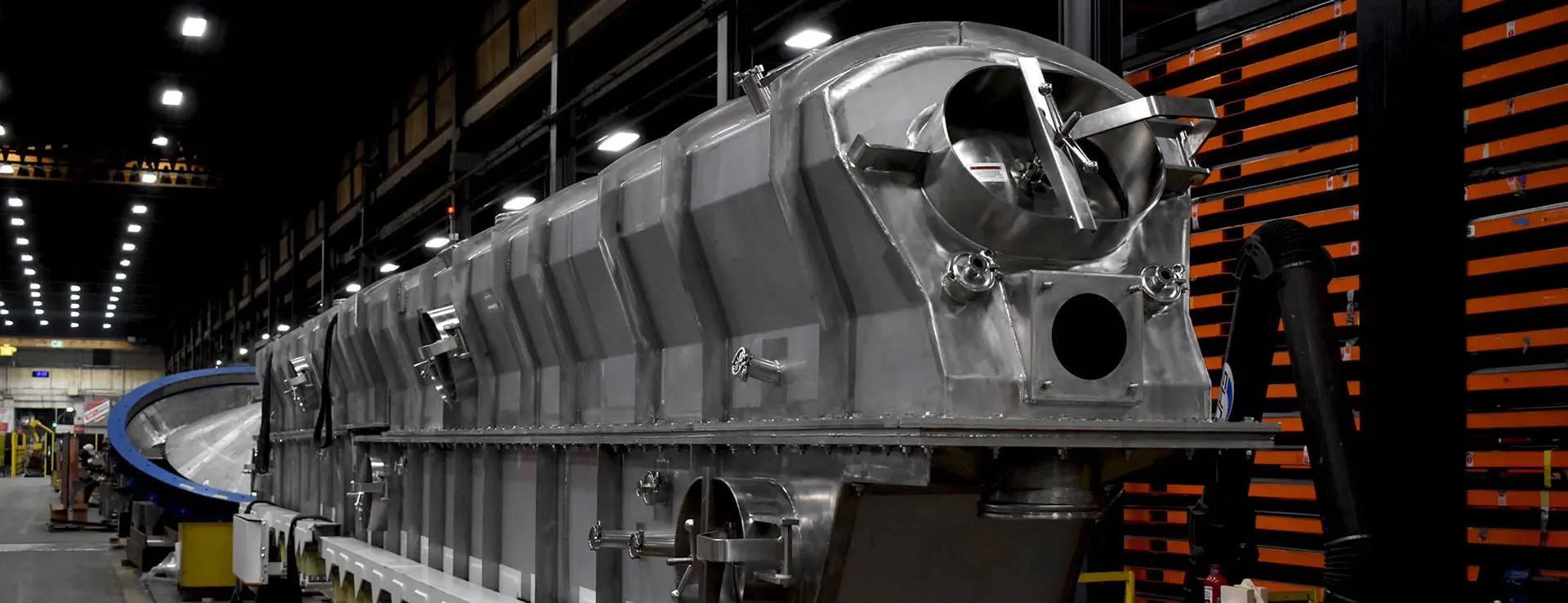
Why Fluidized Bed Dryer Design Makes or Breaks Your Process
Fluidized bed dryer design is the foundation for an efficient drying process. A poor design can become a costly headache. Here’s what every successful design must address:
Essential Design Elements:
- Material characterization – particle size, moisture content, and flow properties
- Fluidization parameters – air velocity, temperature (300°F to 1500°F), and retention time
- Equipment selection – static vs. vibrating systems based on material behavior
- Component design – distributor plates, vessel geometry, and dust collection
- Safety systems – explosion relief, grounding, and compliance requirements
The stakes are high. As one fluid bed expert noted: “Fluid bed dryer success hinges on tailoring equipment design to specific material characteristics.” Get it wrong, and you’ll face process upsets, inconsistent product quality, excessive downtime, and high energy consumption.
The good news? Modern fluidized bed dryers offer high rates of heat transfer, wide applicability, and a small footprint – making them one of the most popular industrial drying technologies. But only when designed correctly.
Common design challenges include handling sticky materials, managing fine particles, and dealing with wide particle size distributions that resist uniform drying. The solution lies in understanding the science of fluidization and matching your design to your material’s specific properties.
Whether you’re drying pharmaceutical granules, food products, chemicals, or minerals, the principles remain the same: characterize your material, understand fluidization behavior, and engineer a system that works with – not against – your product’s natural properties.
The Science of Fluidization: Core Principles for Dryer Design
Picture a bed of sand that suddenly starts behaving like boiling water. That’s the magic of fluidization—and it’s what makes fluidized bed dryer design so effective. When you pass hot air upward through solid particles at the right speed, the particles lift, mix, and create a fluid-like environment perfect for drying.
The science is simple. As gas flows upward, it creates a drag force on each particle. When that drag force overcomes gravity, the particles become suspended and move freely. This critical point is the minimum fluidization velocity – the sweet spot where your particles come alive.
There’s a catch: if the gas velocity is too high, your particles will fly out of the dryer. This upper limit relates to each particle’s terminal velocity. Effective fluidized bed dryer design lies in balancing these two extremes, creating intense particle motion while keeping everything contained.
This delicate dance between drag force and gravity creates ideal conditions for heat and mass transfer. Every particle receives excellent exposure to hot-drying air, resulting in rapid, uniform moisture removal, bed expansion, and homogeneous mixing.
What is Fluidization?
At its core, fluidization happens when upward gas flow – usually hot air – passes through a bed of solid particles. As you increase the airflow, the particles begin to wiggle and separate. At a specific velocity, the entire bed behaves like a liquid. It can flow, mix thoroughly, and even splash. This intense particle motion ensures every particle receives the heat needed for effective drying. For a comprehensive overview of the fluidization phenomenon, see Fluidization on Wikipedia.
The beauty of fluidization extends far beyond drying. As our colleagues explain in Fluidization Creates Both Quicksand and Fluid Bed Processing, this same principle creates both natural phenomena and industrial solutions.
Understanding Fluidization Regimes and Their Impact
Fluidization doesn’t always look the same. Depending on gas velocity and particle traits, your fluidized bed can operate in different regimes, each with unique advantages for drying.
Fixed bed operation occurs at low gas velocities where particles stay put. This is not effective for drying.
Bubbling fluidization occurs above the minimum fluidization velocity. Gas bubbles rise through the bed, creating a gentle boiling effect ideal for many industrial drying applications.
Higher velocities lead to turbulent fluidization, where chaotic bubble movement creates intense mixing suitable for certain materials.
Even higher velocities cause fast fluidization, where particles are carried out of the bed. This is useful for specific applications when paired with external cyclones to return the particles.
The chosen regime dramatically affects dryer performance and product quality. Gentle bubbling suits fragile materials, while turbulent regimes excel with sticky products.
Particle characteristics are also key. The Geldart particle classification system helps predict behavior: Group A (fine, easy to fluidize), Group B (sand-like, bubble vigorously), Group C (very fine, cohesive, tricky), and Group D (large, dense, need high velocities). Understanding your material’s group helps you design the perfect system.
For challenging materials that don’t fluidize easily, mechanical assistance can work wonders – which is where vibrating fluid bed technology shines.
Step 1: Characterize Your Material – The Foundation of Design
Material characterization is like getting to know your material’s personality before designing its ideal environment. For fluidized bed dryer design, we must become intimately familiar with your material’s unique characteristics before sketching the first drawing.
Fluid bed dryers are sensitive to material changes. Get this step wrong, and you’ll face process upsets, inconsistent product quality, and costly downtime. That’s why we always say: “Fluid bed dryer success hinges on tailoring equipment design to specific material characteristics.” It’s the difference between a smooth-running system and a daily headache.
Key Material Properties to Analyze
Every characteristic matters. Here’s why each one is crucial for successful dryer design.
Particle Size Distribution (PSD) is a top priority. Large particles require higher air velocity to fluidize, while small particles can easily be blown out of the dryer. A wide PSD is tricky; the air velocity needed for large particles may blow away the smaller ones, leading to inefficient drying and material loss.
Particle shape also presents challenges. Irregular shapes can interlock and clump, creating dead zones where drying is ineffective.
Bulk density, along with particle size, determines the required air velocity and directly impacts energy needs and equipment sizing.
The moisture story—initial and final moisture content—tells us how hard the dryer must work and drives our heat and airflow calculations.
Specific heat reveals how much energy your material needs to warm up, affecting heat input requirements.
Material fragility dictates the level of turbulence. Delicate products can break apart, creating fines and product loss, while tougher materials can handle vigorous fluidization.
Chemical composition affects the materials of construction (for corrosion resistance) and the maximum operating temperature. It also informs safety considerations like off-gassing.
Finally, we assess for troublemakers: abrasive materials that wear down equipment and sticky materials that gum up distributor plates and form clumps. Sticky materials often require specialized designs, like vibrating fluid beds, to ensure smooth operation.
The Critical Role of Pretreatment
Sometimes, raw material needs pretreatment to be ready for the fluid bed.
Size reduction (crushing, grinding) or milling creates a more uniform particle size that fluidizes predictably and dries evenly.
For very fine or dusty products, agglomeration or pelletizing forms larger particles, improving fluidization and reducing the risk of them being blown out.
A uniform feed is critical. For example, inconsistent raw sludge can be pretreated with back-mixing to create a consistent feed that dries efficiently, a topic explored in our article on Enhancing Sludge Drying Efficiency with Back-Mixing Technology.
The bottom line: thoroughly characterizing your material and using appropriate pretreatment is the foundation for a fluidized bed dryer design that delivers consistent, trouble-free operation for years to come.
Step 2: The Fluidized Bed Dryer Design Process
With a deep understanding of your material, we begin the actual fluidized bed dryer design process. This step combines engineering principles, thermodynamic calculations, and practical experience to create a system that fits seamlessly into your production line.
We start with the big picture: your process goals, capacity requirements, and integration with existing systems. The data from material characterization guides every decision, from scale-up to component selection. For deeper insights, our white paper on Considerations for the Selection of a Vibratory Fluid Bed Dryer provides a comprehensive guide.
Key Parameters in Fluidized Bed Dryer Design
Getting these critical parameters right is like tuning a high-performance engine.
Inlet air temperature is a key parameter, ranging from a gentle 300°F for delicate materials to 1500°F for robust minerals. The choice is dictated by the material’s heat sensitivity and required drying rate to avoid product damage or energy waste.
Airflow velocity controls the fluidization. Too low, and particles don’t move; too high, and they are lost from the system. Finding the balance is crucial.
Retention time management is essential for hitting the target moisture content. This is primarily controlled through weir height adjustment, which acts like a dam to regulate bed depth and the length of time material stays in the dryer.
The thermal processing curve shows the drying journey, typically a constant rate period followed by a falling rate period. Understanding this curve helps optimize conditions and prevent product degradation.
Critical Components in Fluidized Bed Dryer Design
The physical components are where theory meets reality.
The distributor plate design is arguably the most critical component, as it ensures uniform air distribution. While traditional drilled hole plates are standard, they can suffer from uneven airflow and clogging. Modern fluidized bed dryer design uses advanced distributor plates with superior airflow characteristics. They deliver high jet velocity at a 90-degree angle for optimal fluidization, handling fine particles without clogging. Their increased open area allows for lower air volumes and velocities, saving on energy costs.
Dryer vessel geometry, including the hood design, is also vital. A properly designed wide hood reduces airflow velocity above the bed, keeping particles in the dryer.
The air handling system (heaters, blowers, ductwork) is the dryer’s life support, while the dust collection system (cyclones, baghouses) captures fine particles and ensures environmental compliance.
Finally, weirs and discharge gates provide precise control over product flow, allowing fine-tuning of retention time and bed depth.
The Importance of Pilot Testing
To avoid costly mistakes, pilot testing is essential. Designing a dryer for a new material without it is a high-stakes gamble. We always advise clients to conduct test work in a facility to confirm drying feasibility and work out process criteria before committing to commercial-scale design.
Pilot testing confirms feasibility and helps develop process criteria by nailing down optimal temperature, airflow, and retention time using your actual material.
Data collection during testing is comprehensive, tracking temperatures, pressures, flow rates, and more. This data becomes the blueprint for the commercial unit.
Design optimization occurs through this iterative process, ensuring the final design is custom-custom for peak performance. For example, when Drying Pigments for Paint, pilot testing is non-negotiable to ensure color integrity.
Pilot testing turns unknowns into knowns, changing a gamble into a confident investment in your operation’s future.
Step 3: Selecting the Right Fluidized Bed Dryer Solution for Your Application
Now we select the perfect fluidized bed dryer design for your needs. Like choosing the right tool for a job, matching the dryer type to your material is critical for success. For a broader perspective, see our guide on 5 Types of Industrial Drying Systems.
The key is matching your material’s personality to the right dryer type.
| Feature | Conventional (Static) Fluid Bed Dryers | Vibrating Fluid Bed Dryers |
|---|---|---|
| Suitable Materials | Free-flowing, uniform particles | Wide range including sticky, cohesive materials |
| Particle Size Range | Narrow distribution preferred | Handles wider size distributions |
| Attrition Risk | Higher with fragile materials | Lower due to gentler handling |
| Typical Applications | Chemical processing, minerals | Food, pharmaceuticals, difficult materials |
Conventional (Static) Fluid Bed Dryers
Conventional static fluid bed dryers are the workhorses of the industry. Their simple, proven design works best with free-flowing, uniform particles that fluidize easily. They are popular in chemical and mineral processing where materials are relatively uniform and non-sticky. A key advantage is the potential for submerged heat exchangers, which can boost thermal efficiency by providing additional heat transfer surface area within the bed.
Vibrating Fluid Bed Dryers
Vibrating fluid bed dryers add a game-changing element: mechanical assistance. Gentle, controlled vibration helps move stubborn particles and prevents “dead zones” common in static systems.
The magic of vibrating fluid bed dryers is their versatility. They can handle wider particle size distributions without the uniformity issues of static systems. They truly shine with sticky or fragile materials, as the vibration prevents clumping and provides gentler handling that reduces particle breakage. The plug flow control offers a more predictable material path, giving you better control over retention time. This controlled vibration also allows for operation at lower air velocities, reducing product entrainment and operating costs. To dive deeper, explore Vibrating Fluid Bed Dryers: How They Work.
Custom-Engineered Fluid Bed Dryer Solutions
When standard solutions won’t work for a unique or challenging material, our custom-engineered fluid bed dryer solutions are the answer.
For cohesive or difficult-to-fluidize products, we can incorporate specialized mechanical aids, unique distributor plates, or custom air flow patterns. We offer both batch and continuous options to fit your production needs.
The beauty of custom engineering is combining the best features of different technologies. We can create a unique solution crafted for your success, whether that means special materials of construction for corrosive products or a hybrid design. Our analysis of Flash Drying vs. Fluid Bed Drying can help you understand why fluid bed technology might be the perfect fit.
The key is working closely with our engineering team to understand not just what you’re drying, but how it fits into your overall process. Every fluidized bed dryer design we create is a unique solution crafted specifically for your success.
Conclusion
Getting your fluidized bed dryer design right isn’t just about following a checklist – it’s about understanding the delicate dance between science and your specific material’s personality. Think of it like cooking: you can follow a recipe, but the best chefs know how to adjust for their ingredients.
We’ve walked through the essential steps together: characterizing your material like a detective gathering clues, understanding the fluidization process that transforms solid particles into a fluid-like state, and designing a system that works with your product rather than against it. Each step builds on the last, creating a foundation for success.
The beauty of modern fluidized bed dryer design lies in its flexibility. Whether your material is as delicate as pharmaceutical granules or as robust as industrial minerals, there’s a solution. Conventional static systems work beautifully for free-flowing materials, while vibrating fluid bed dryers tackle the challenging sticky or fragile products that make other drying methods throw in the towel.
But here’s what really matters: custom engineering makes the difference. Cookie-cutter solutions might work for cookies, but your drying process deserves better. Every distributor plate, every airflow calculation, every safety system should be custom to your material’s unique characteristics and your production goals.
The investment in proper design pays dividends in energy efficiency, consistent product quality, and operational reliability. When your dryer runs smoothly day after day, meeting your moisture targets while keeping energy costs in check, you’ll know the upfront engineering effort was worth every minute.
At Carrier Vibrating Equipment, we’ve been solving these puzzles for decades. Our custom-engineered solutions combine proven engineering principles with real-world experience, ensuring your dryer doesn’t just work – it excels.
Ready to transform your drying process? For a custom-engineered drying solution that meets your exact specifications, explore our vibrating fluid bed dryers.