
Why Integrated Drying and Cooling Systems Matter for Industrial Processing
Integrated Drying and Cooling Systems combine two critical thermal processing steps into a single, compact unit for handling bulk materials. Instead of moving your product through separate equipment, these systems dry and cool materials in one continuous process.
Quick Answer: What You Need to Know
- Definition: A single piece of equipment that both removes moisture from bulk materials and reduces their temperature to safe handling levels
- Key Benefit: Saves 40-60% of floor space compared to separate dryer and cooler units
- Energy Savings: Can reduce primary energy consumption by 50% or more through heat recovery
- Best For: Bulk materials like food products, chemicals, minerals, and pharmaceuticals that need both drying and cooling
Industrial drying accounts for up to 70% of energy consumption in some manufacturing sectors. That is a major operational cost. When you add a separate cooling step, you increase your equipment footprint, add material handling complexity, and miss opportunities to recover valuable heat.
Research shows that heat recovery alone can reduce steam consumption by more than 10%. Integrated systems take this further by using exhaust heat from the cooling section to preheat incoming drying air. This closed-loop approach does more than save energy: it stabilizes product temperatures, reduces thermal shock to sensitive materials, and simplifies your process flow.
For operations managers facing space constraints, rising energy costs, or product quality challenges, integration is rapidly becoming the standard for efficient thermal processing of bulk materials.
The Compelling Case for Integration: Why Combine Drying and Cooling?
In bulk material processing, efficiency is key. We constantly seek to optimize operations, reduce costs, and improve product quality. This is where Integrated Drying and Cooling Systems truly shine. By combining these two crucial steps, we open up a cascade of benefits that separate units simply can’t match.
Imagine an efficient processing line, smaller energy bills, and a consistently perfect product. That’s the promise of integration. It’s a smarter approach to thermal processing that impacts everything from capital expenditure to final product integrity. These systems can transform facilities, turning bottlenecks into smooth, continuous flows.
Streamlined Footprint and Reduced Capital Costs
An immediate, tangible benefit of an integrated system is the dramatic reduction in physical footprint. Traditional setups often involve a large dryer and an equally large separate cooler, each requiring its own drive systems, material-handling equipment, and valuable floor space. Manufacturers often struggle with space constraints, and integrated systems offer a neat solution.
By merging the drying and cooling processes into a single unit, we can significantly minimize the required space. This isn’t just about saving a few square feet; it’s about optimizing your entire facility layout. In new plants, space is at a premium, and in existing facilities, adding a separate, large cooler might not be an option. Our integrated solutions are compact, making them ideal for new installations and retrofits where space is a critical factor.
This streamlined footprint also reduces capital costs. Fewer pieces of equipment mean less spending on machinery, installation, and associated material-handling systems, such as conveyors, required between separate units. As we often say, sometimes One Dryer is Better Than Two! This simplifies purchasing, engineering, and commissioning, getting you to full production faster and more cost-effectively.
Improved Energy Efficiency and Sustainability
Energy efficiency is a fundamental requirement for modern industrial operations. Drying is notoriously energy-intensive, consuming a significant portion of a plant’s energy budget. Adding a separate cooling step often vents valuable heat into the atmosphere. Integrated systems prevent this.
The magic lies in heat recovery. In an integrated system, the air used to cool the material becomes preheated. This preheated air can then be strategically recirculated as make-up air for the drying section’s combustion chamber. This clever closed-loop approach significantly reduces the dryer’s fuel consumption, resulting in substantial energy savings. We’ve seen potential savings of 50% or more in primary energy compared to separate units. For example, heat recovery systems alone have been shown to reduce steam consumption by over 10%.
Beyond cost savings, this approach improves sustainability by lowering overall energy consumption and reducing your carbon footprint. It’s a win-win: better for your bottom line and the environment. The ongoing advancement of drying heat pumps, as explored in studies such as Drying heat pumps – Part I: System integration, further highlights the potential for energy optimization in integrated thermal processing.
Superior Product Quality and Control
For many bulk materials, especially heat- or moisture-sensitive ones, maintaining product quality is paramount. Uncontrolled temperature fluctuations or excessive heat can cause degradation, discoloration, or altered physical properties. This is where Integrated Drying and Cooling Systems excel in preserving product integrity.
By combining drying and cooling in one continuous process, we achieve precise temperature and moisture control. This uniform processing minimizes thermal shock, which can damage delicate materials. A separate cooler might struggle to cool a product from a hot dryer gently and consistently. An integrated system, however, can uniformly dry and cool products quickly, ensuring their natural qualities remain intact.
This precise control is crucial for preventing issues like burning discharge belts, affecting downstream equipment, or causing fires if hot product is stored in silos. Our commitment to Optimal Size Separation and Gentle Handling for Peak Drying Efficiency means your materials are treated with care, resulting in a higher quality, more consistent end product.
Integrated vs. Separate Systems: A Direct Comparison
Let’s compare how integrated systems stack up against traditional separate drying and cooling setups:
| Metric | Integrated Drying and Cooling Systems | Separate Drying and Cooling Units |
|---|---|---|
| Footprint | Compact, significantly smaller (40-60% less floor space) | Extensive, requires large area for two distinct units |
| Energy Use | Lower, leverages heat recovery (50%+ savings potential) | Higher, often wastes exhaust heat, separate energy inputs for cooling |
| Capital Cost | Potentially higher initial investment for specialized design, but lower overall due to fewer units and less material handling equipment | Lower per individual unit, but higher total for two systems plus interconnecting equipment |
| Product Quality Control | Superior, precise temperature/moisture control, reduced thermal shock, uniform processing | Variable, less direct control over transition, potential for thermal shock |
| Maintenance Complexity | Simpler, single system to maintain, fewer moving parts overall | More complex, two separate systems, more points of potential failure |
How Integrated Drying and Cooling Systems Work: Technology in Action
The elegance of Integrated Drying and Cooling Systems lies in their sophisticated engineering, which brings together the best principles of thermal processing. These are not just two machines bolted together; they are carefully designed units in which drying and cooling phases are intrinsically linked, often sharing airflow and controls. This holistic approach ensures maximum efficiency and product quality.
At their heart is a deep understanding of heat and mass transfer, fluid dynamics, and material characteristics. The goal is always to achieve uniform, consistent results without compromising the material. We leverage decades of experience designing custom thermal processing equipment to ensure every system works seamlessly. For a deeper dive into the fundamentals, explore “Understanding Thermal Processing Equipment: How It Works.”
Key Design Principle: Vibrating Fluid Bed Technology
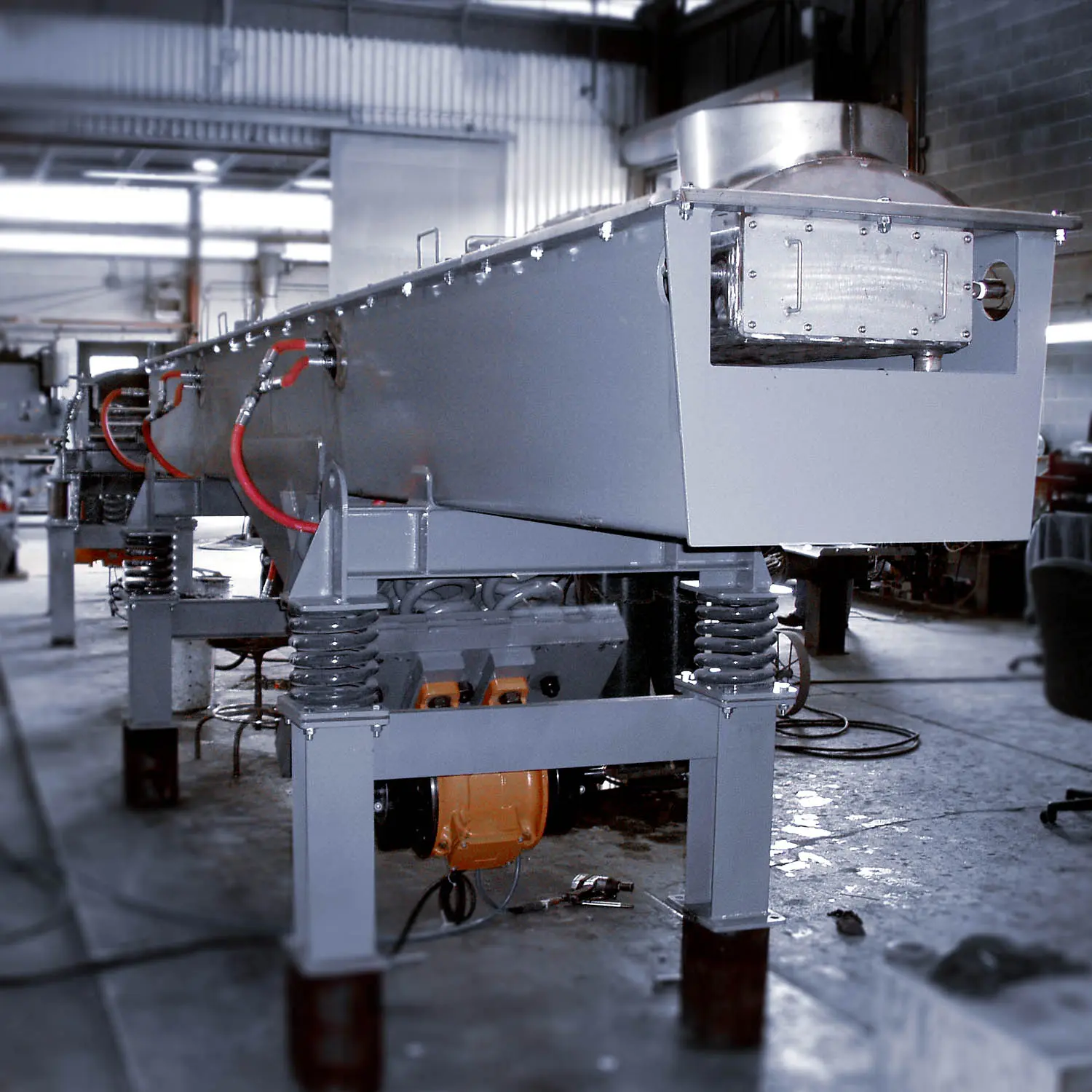
One of the most effective technologies we employ is the vibrating fluid bed. This design offers unparalleled control and efficiency, particularly for bulk materials.
Here’s how it works: material is introduced onto a perforated deck, through which a controlled stream of air is passed. This air “fluidizes” the material, suspending it in a gentle, buoyant state. Simultaneously, the bed vibrates, conveying the material horizontally. This combination of fluidization and vibration ensures:
- Uniform Material Distribution: The entire bed of material is evenly exposed to the drying or cooling air, preventing hot spots or wet zones.
- Controlled Residence Time: The vibratory action and adjustable dams enable precise control of the material’s residence time in the system. This is crucial for achieving specific moisture and temperature targets. For materials with a wide particle size distribution, the sloped fluidized grid design allows for effective processing of both fines and coarser particles simultaneously. Fines move faster, while adjustable dams can hold coarser material longer for complete processing.
- Gentle Handling: Unlike more aggressive methods, vibrating fluid beds minimize attrition and breakage of delicate materials, preserving their structural integrity. This gentle processing is particularly beneficial for products with poor fluidization properties or that are sticky, as the vibration helps maintain continuous flow.
This technology is the backbone of our Fluid Bed Dryers and Fluid Bed Coolers, proving that when drying and cooling are integrated, the results are superior.
Types of Integrated Drying and Cooling Systems
While the vibrating fluid bed is a cornerstone, we offer a range of Integrated Drying and Cooling Systems customized for specific material characteristics and process requirements. Our expertise lies in custom engineering solutions that precisely match your needs.
- Vibrating Fluid Bed Dryers and Coolers: These are our flagship integrated systems. They combine the benefits of fluidization and vibration for highly efficient and gentle thermal processing. They are truly integrated, performing both functions within a single unit. Our Vibrating Dryers and Vibrating Coolers are often designed as a single, continuous system.
- Indirect Heat Exchangers (Bulk Material Heat Exchangers): For applications requiring gentle material handling or where direct contact with process air is undesirable, we utilize Bulk Material Heat Exchanger technology to heat or cool material through indirect contact surfaces. These systems provide precise temperature control without direct airflow and are well suited for continuous thermal conditioning and cooling applications.
- Flash Dryers: While often used for drying alone, flash dryers can be integrated into a system for rapid, low-heat drying of powders, pastes, and slurries, especially for heat-sensitive materials. Their short residence time and high heat-transfer rates make them well-suited for rapid moisture removal.
The key across all these types is the intelligent design that ensures efficient heat and mass transfer to achieve optimal drying and cooling within a unified process.
The Role of Advanced Control Systems and Automation
In any modern industrial process, the control system is the brain. For Integrated Drying and Cooling Systems, it’s brilliant. Advanced controls and automation are critical for optimizing performance, ensuring product quality, and maximizing energy efficiency.
Our systems incorporate sophisticated PLC (Programmable Logic Controller) controls that monitor and adjust process parameters in real-time. This includes:
- Temperature Sensors: Strategically placed in the drying and cooling zones to maintain precise temperature profiles, often accurate to a fraction of a degree. This prevents overheating and ensures optimal cooling.
- Moisture Sensors: Continuously measure material moisture content, allowing the system to adjust drying parameters to achieve the desired final dryness without over-drying.
- Automated Adjustments: Based on sensor feedback, the control system can automatically modify airflow rates, temperature setpoints, vibration intensity, and material residence time. This dynamic response ensures consistent product quality despite variations in incoming material.
- Data Logging and Analytics: Modern control systems log vast amounts of operational data. This data is invaluable for process optimization, troubleshooting, predictive maintenance, and demonstrating compliance with quality standards.
- System Reliability and Safety: Automation is also crucial for system reliability and safety, allowing for remote monitoring, automated startup/shutdown sequences, and rapid response to any operational anomalies.
The goal is to create an “efficiently controlled” system where dewatering capability is perfectly matched with cooling capacity, ensuring safe operation and the best possible product quality. This level of control transforms a complex thermal process into a smooth, predictable, and highly efficient operation.
Key Applications: Which Industries and Materials Benefit Most?
The versatility of Integrated Drying and Cooling Systems makes them invaluable across a wide range of industries, particularly those handling bulk solids, powders, granules, and aggregates. Wherever materials need to be dried to a specific moisture content and then cooled to a safe handling or storage temperature, these systems offer a superior solution.
Think about materials that are delicate, prone to caking, or require precise thermal treatment to maintain their quality. These are the sweet spots for integrated systems. They prevent the thermal shock that can occur when moving hot, dry material into a separate, cold environment, ensuring the final product meets the strictest specifications. We’ve seen these systems become indispensable in various sectors, proving their worth across different 5 Types of Industrial Drying Systems.
Common Materials Processed
Our integrated systems are adept at handling a diverse range of bulk materials, ensuring optimal processing for each:
- Foods: From cereals, snack foods, and pet food kibble to spices and grains, these systems are crucial for achieving stable moisture content and cooling products for packaging and storage, preserving flavor and texture.
- Chemicals: Polymers, resins, fertilizers, and various chemical compounds often require precise drying and cooling to prevent agglomeration, ensure purity, and prepare them for subsequent processing or packaging.
- Minerals: Materials such as sand, salt, limestone, and aggregates benefit from uniform drying and cooling to remove surface moisture and lower temperature for handling or further processing. For instance, Sand Drying Equipment often incorporates cooling to prevent downstream equipment issues.
- Pharmaceuticals: The delicate nature of pharmaceutical powders and crystals requires extremely gentle, precise thermal processing to maintain efficacy and prevent degradation. Integrated systems provide the controlled environment needed.
- Biomass and Recycling: This includes materials like woody biomass, agricultural products, municipal solid waste (MSW) used for alternative fuels, and processed sludge or biosolids. Integrated systems are vital for reducing moisture to increase calorific value, reduce emissions, and prepare materials for safe disposal or reuse. Our expertise in enhancing sludge drying efficiency is a testament to this.
Industries Leveraging Integrated Drying and Cooling Systems
The industries that benefit most from our Integrated Drying and Cooling Systems are those where product quality, energy efficiency, and operational reliability are paramount:
- Food Processing: To ensure shelf-stability, texture, and taste of various food products, from breakfast cereals to pet food.
- Chemical Manufacturing: For precise control over the properties of chemical compounds, polymers, and fertilizers, preventing caking and ensuring consistent quality.
- Pharmaceutical Production: Where strict environmental control and gentle processing are critical for maintaining the integrity and efficacy of active pharmaceutical ingredients and excipients.
- Mining and Minerals: For drying and cooling industrial sands, salts, and other mineral products, optimizing them for various applications.
- Waste Management and Renewable Fuels: Processing municipal and industrial sludge, biomass, and other waste materials to reduce volume, stabilize them, or prepare them as renewable energy sources.
These industries, with their diverse materials and rigorous demands, find that integrated systems provide the consistent, high-quality results they need to succeed.
Implementation and Optimization: From Blueprint to Reality
Bringing an Integrated Drying and Cooling System from concept to reality involves careful planning, precise engineering, and a deep understanding of your specific process. Whether you’re building a new facility or upgrading an existing line, the journey to optimized thermal processing requires thoughtful consideration of design, potential challenges, and validation through testing. Our goal is always to deliver a solution that not only meets but exceeds your expectations. For a comprehensive overview of selection considerations, our White Paper: Considerations for the Selection of a Vibratory Fluid Bed Dryer offers valuable insights.
Adapting for Existing Facilities vs. New Installations
The decision to implement an Integrated Drying and Cooling System can take different paths depending on your facility’s current state:
- New Installations (Greenfield Projects): For entirely new plants or production lines, we have the freedom to design the integrated system from the ground up. This allows for optimal layout, seamless integration with upstream and downstream equipment, and maximum efficiency. It’s a chance to build in all the benefits of integration from day one, without the compromises often associated with retrofitting.
- Existing Facilities (Retrofitting): Adapting integrated systems within existing facilities can pose unique challenges, primarily due to space constraints. Traditional separate dryers and coolers can occupy substantial floor area, and adding a new large cooler may not be feasible. However, this is where the clever design of integrated systems shines. A compact integrated cooler can often be adapted to existing equipment by modifying the dryer’s discharge breeching. This provides a cooling solution without demanding the extensive footprint a separate cooler would require, offering a lifeline to facilities looking to improve efficiency without major structural overhauls. Our Custom Solutions are specifically designed to meet these unique challenges.
Whether it’s a greenfield project or a retrofit, our approach is to provide individually engineered solutions that perfectly fit your operational needs.
Overcoming Challenges and Limitations of Integrated Drying and Cooling Systems
While Integrated Drying and Cooling Systems offer a wealth of benefits, it’s important to acknowledge and address potential challenges to ensure successful implementation. No system is truly “one-size-fits-all,” and careful design is key.
One primary consideration is the material characteristics. Materials can vary widely in particle size distribution, density, and flow properties. For instance, some fluidized bed systems can experience segregation (where fines and coarse particles separate), high pressure drops, or increased fines production. However, our advanced vibratory fluid-bed designs are engineered to address these issues. The combination of vibration and a sloped bed enables effective processing of materials with a wide range of particle sizes and densities, making it much more forgiving than conventional fluid beds.
Stickiness is another challenge. Some materials, when heated, can become sticky and agglomerate, hindering fluidization and flow. Vibrating fluid beds are particularly effective here, as the mechanical vibration helps to keep the material moving and prevents clumping, even for products with poor fluidization properties.
Finally, while integrated systems reduce overall complexity by combining functions, the design itself can be intricate. Ensuring proper heat and mass transfer within a single unit requires sophisticated engineering to avoid issues like uneven drying or cooling. This underscores the importance of working with experienced manufacturers who understand the nuances of these systems. With proper design, integrated systems offer easier maintenance access and lower overall complexity than managing two separate units.
The Importance of Pilot Testing
Before committing to a full-scale Integrated Drying and Cooling System, pilot testing is an absolutely critical step. We cannot overstate its importance. Think of it as a dress rehearsal for your industrial process.
Pilot testing allows us to:
- Process Validation: Confirm that the chosen technology and design principles are effective for your specific material. Every material behaves differently, and what works for one might not work for another.
- Material Testing: Observe how your material responds to drying and cooling conditions in a controlled environment. This helps us understand its unique characteristics, including optimal fluidization velocity, heat-transfer rates, and potential for attrition or stickiness.
- Optimizing Parameters: Experiment with various operating parameters—airflow rates, temperatures, vibration intensity, residence times—to identify the most efficient and effective settings for your desired end product. This ensures peak performance and energy efficiency in the final system.
- Ensuring Performance: Provide concrete data and guarantees for the full-scale system’s performance. It eliminates guesswork and reduces risk, giving you confidence in your investment.
Our dedicated Lab Testing facilities and ongoing Research & Development efforts are central to this process. By conducting thorough pilot tests, we ensure your custom-engineered integrated system performs exactly as expected, delivering consistent results and maximum return on investment.
Frequently Asked Questions about Integrated Drying and Cooling Systems
We often get asked similar questions about these innovative systems. Here are some of the most common inquiries, along with our insights:
How much energy can an integrated system really save?
Energy savings depend on the specific application, but recovering heated air from the cooling section can significantly reduce fuel use in the drying section, with potential savings of 50% or more in primary energy compared to separate, non-integrated units. This is achieved through efficient heat-exchange and recirculation strategies that capture and reuse thermal energy that would otherwise be wasted.
Can integrated systems handle materials with wide particle size distributions?
Yes, advanced designs, such as vibrating fluid beds, are well-suited to materials with varying particle sizes. The combination of vibration and controlled airflow ensures that both fine and coarse particles are processed effectively and uniformly. Adjustable features, such as bed slope and dams, enable precise control of material movement and residence time, accommodating different particle behaviors.
A Smarter Path to Thermal Processing
We’ve explored the compelling world of Integrated Drying and Cooling Systems and uncovered the myriad benefits they offer to modern industrial processes. From their compact design that liberates valuable floor space to their remarkable energy efficiency achieved through intelligent heat recovery, these systems represent a significant leap forward in thermal processing technology.
We’ve seen that integrating these two critical steps delivers superior product quality, providing precise control over temperature and moisture that preserves the integrity of even the most sensitive materials. The heart of these systems, often powered by advanced vibrating fluid bed technology, ensures gentle handling and uniform processing across a wide range of bulk materials. With sophisticated control systems, optimal performance is not just a goal but a guaranteed outcome.
At Carrier Vibrating Equipment, we believe the future of thermal processing is integrated, efficient, and custom to your unique needs. By integrating drying and cooling into a single, efficient unit, industries can overcome common challenges of space, energy, and product quality, paving the way for smarter, more sustainable manufacturing.
To explore how a custom-engineered solution can transform your process, learn more about our Drying and Cooling applications. We’re here to help you design your blueprint for smarter processing.