


Drying is one of the most performed industrial processes, and people have been drying materials since fire was discovered. Since it is such an old and important process, there are numerous methods of industrial drying, but selecting the correct one is essential for producing a high-quality end product.
Choosing the wrong type of dryer technology can lead to problems with the material, including burnt or not fully dried due to lower drying efficiencies. Some materials will clump when dried incorrectly, melt if exposed to too hot a temperature, or rot and spoil if not dried completely. Some dryers can perform additional processing along with the drying, and if this is not done, the product can be ruined.
Bandtrockner
One popular type of dryer is the belt dryer, which mechanically conveys the material on a moving conveyor belt, exposing it to the heat source suspended above. These dryers are good for when the material cannot be agitated or mixed while drying, or when emissions are a concern. Even though they have a large footprint, they can be flexible enough to fit within an area, and they can often elevate material while drying.
Belt dryers are not able to dry thoroughly to the lower residual moistures that other dryers can reach. Because the material is stationary on the belt, there is an inconsistent level of drying where the surface has been dried but inner layers that were not exposed retain their moisture. Trying to fix this by increasing temperatures or residence time can result in the top layer burning by the time the inner layers dry.
Belt dryers also often have a higher operation and maintenance costs than other dryers, since the belt will wear out and needs constant adjustment to keep the tension correct. Material will fall under the belt while being conveyed and needs to be cleaned before it builds up, causing sanitation and abrasion issues. Belt dryers have also been attributed to several combustible dust explosions ignited by the friction heat of the belt.
Wirbelschichttrockner
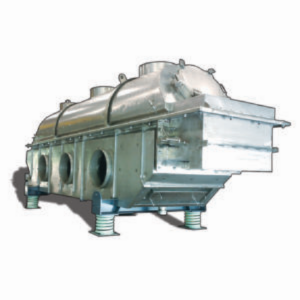
Ein weiterer beliebter Typ von Industrietrocknern ist der Wirbelschichttrockner, der entweder statisch oder vibrierend sein kann. Beim Wirbelschichttrockner wird das Material über eine perforierte Platte bewegt, unter die Luft geblasen wird. Diese Luft versetzt das Material in einen fluidisierten Zustand, so dass es fließt und sich wie eine Flüssigkeit verhält. Wenn die Luft erwärmt wird, kann sie jedes Teilchen des zu trocknenden Materials vollständig einhüllen, wodurch sichergestellt wird, dass die Trocknung gleichmäßig und ohne heiße Stellen erfolgt und das Material nicht nass bleibt. Das Hinzufügen von Vibrationen hilft, ansonsten hartnäckige Materialien zu verflüssigen und zu bewegen und steigert die Effizienz.
The airflow and temperature can be adjusted for each individual material, and the equipment can be custom-engineered and sized for the desired residency time to properly dry without burning. Because of fluidization, the material is thoroughly mixed, resulting in a homogeneous end product, and any fines can be removed and captured later. The fluid bed dryers can also be built with different temperature zones, allowing the material to be cooled and stabilized in the same piece of equipment, preventing the condensation that belt dryers suffer from.
Fluid bed dryers can be built with food-grade stainless steel and can include clean-in-place nozzles and removable hoods to make cleaning easy and efficient. Dried material can also be back-mixed to help dry difficult-to-process materials.
Contact a Carrier Vibrating Equipment engineer today to discuss the various drying methods and which one best suits your specific processing requirements.