
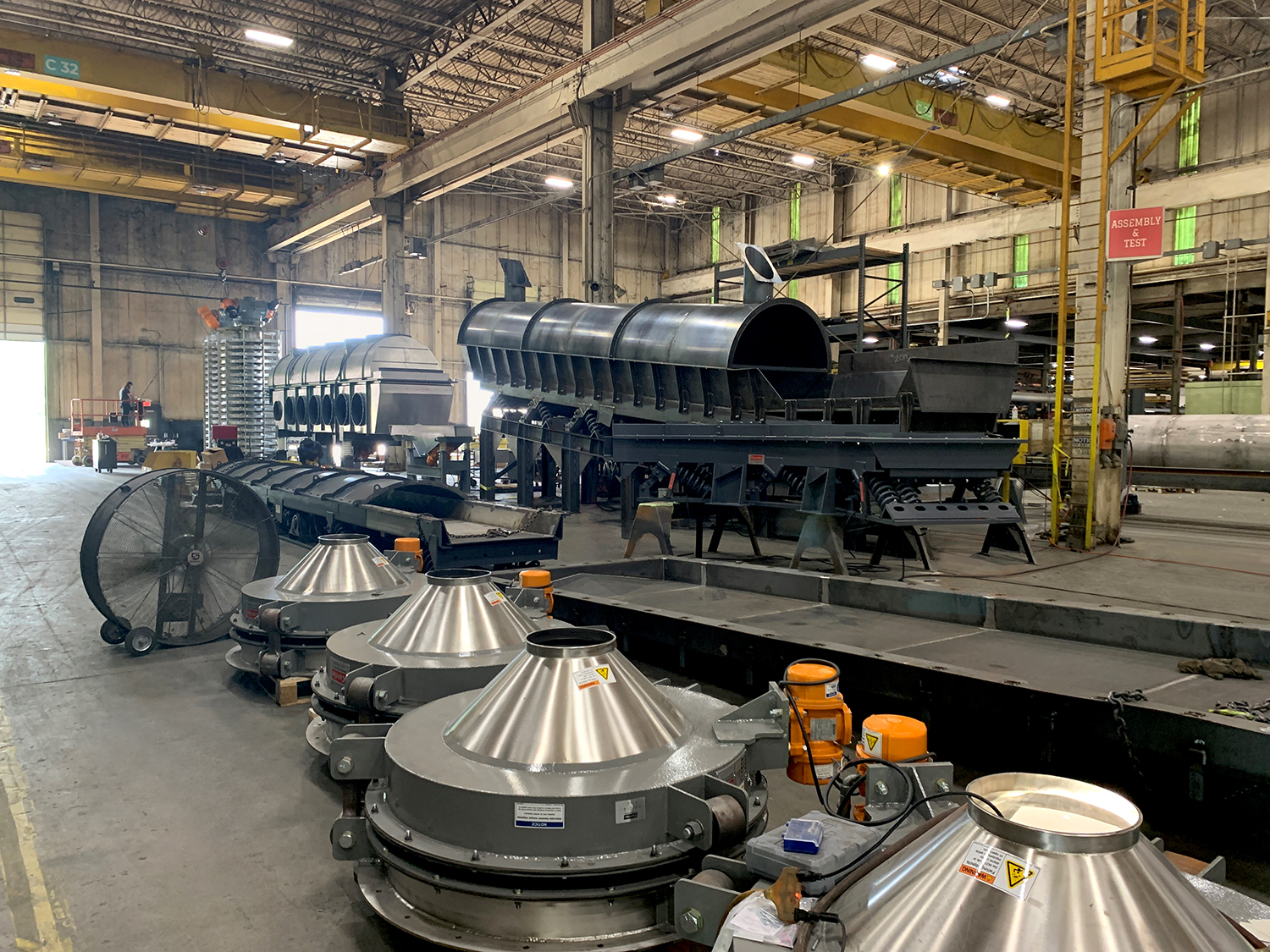
Why Industrial Process Equipment Forms the Backbone of Modern Manufacturing
Industrial process equipment represents the essential machinery that transforms raw materials into finished products across countless manufacturing operations. These sophisticated systems handle everything from conveying and screening to heating, cooling, and mixing – serving as the critical link between basic materials and the products we use every day.
Key Types of Industrial Process Equipment:
- Material Handling: Vibrating conveyors, feeders, and custom transport systems
- Thermal Processing: Industrial dryers, coolers, and fluid bed systems
- Separation & Finishing: Screening equipment, shakeouts, and classification systems
- Mixing & Storage: Blenders, mixers, tanks, and storage solutions
The global industrial process equipment market reached $75.4 billion in 2022 and is projected to grow to $110.5 billion by 2030 – clear evidence of how crucial this machinery has become for modern production.
But here’s what makes this equipment truly valuable: it’s not just about moving materials from point A to B. The right process equipment dramatically improves efficiency, ensures consistent product quality, and helps manufacturers meet strict regulatory standards like FDA and 3A guidelines. Many facilities also follow internationally recognized quality systems such as ISO 9001.
“Equipment suppliers’ equipment meets 3A, FDA, BPE, CE guidelines and is manufactured in ISO 9001 facilities,” according to industry standards – highlighting how quality equipment directly supports compliance and operational excellence.
Whether you’re processing food ingredients, pharmaceutical compounds, or industrial chemicals, selecting the right equipment can mean the difference between smooth operations and costly bottlenecks.
The Core Components: Common Types of Industrial Process Equipment
Think of industrial process equipment as the orchestra of manufacturing – each instrument playing its unique part. Without these essential components working together, even the most advanced facility would grind to a halt.
Let’s explore the key players that make modern manufacturing possible.
Material Handling and Transport
Material handling equipment is the circulatory system of a manufacturing facility, moving materials smoothly between processes.
Vibrating Conveyors are a key component, using controlled vibrations to gently move bulk materials. They are exceptionally versatile, capable of handling materials that are hot, abrasive, or fragile. These conveyors can be custom-designed for unique challenges, from food processing to mining operations.
Feeders work with conveyors to regulate material flow from storage bins and hoppers. They ensure a steady, controlled pace, preventing overloads and bottlenecks for a smooth workflow.
When standard solutions are insufficient, custom transport systems engineered for specific applications are necessary. For example, specialized vibratory pan feeders can optimize screen efficiency in recycling facilities or handle scorching materials in steel plants.
Thermal Processing
Precise temperature control is crucial for product quality. Thermal processing equipment provides this control for drying, cooling, and reacting.
Industrial Dryers remove moisture with high precision. Fluid bed dryers are particularly effective, suspending particles in heated air for uniform drying, which is ideal for food grains, chemicals, and pharmaceuticals.
Industrial Coolers lower temperatures after heating to prevent spoilage, ensure stability, and prepare materials for packaging. They often use fluid bed technology with ambient or chilled air.
Fluid bed dryers create a “fluidized bed” where solid particles are suspended in a gas stream. This maximizes contact between the gas and particles for highly efficient heat and mass transfer. Many systems include integral bagtops to capture fine particles. The fluidization principle has revolutionized how industries approach drying and cooling processes.
Reactors designed for thermal processing are vessels that maintain specific temperature and pressure conditions for chemical reactions, vital for synthesizing drugs and other compounds.
Many operations also require custom heating and cooling solutions to integrate multiple processes, handle unique materials, or fit into tight facility spaces.
Separation and Finishing
After initial processing, materials often require sorting and refining to meet quality standards.
Screening Equipment separates materials by particle size. This is crucial for quality control, improving process efficiency, and protecting downstream equipment in industries from mining to recycling.
Shakeouts are robust machines used in foundries to separate metal castings from sand molds after cooling. They are built to withstand high temperatures and abrasive materials, leaving clean castings ready for finishing.
Mixing and Storage
Mixing and storage are fundamental to many processes.
Mixers and blenders are essential for creating homogeneous mixtures, from food ingredients to pharmaceutical compounds. The market for this equipment is projected to reach $10.2 billion by 2027, reflecting its importance.
Industrial tanks are used to store liquids, slurries, and bulk solids, often facilitating batch processing. They are commonly made from materials like stainless steel or HDPE to meet industry requirements.
Agitators are integrated with tanks to keep mixtures uniform, while silos are large structures for storing bulk materials like grains and powders, keeping them ready for processing.
Why Modern Equipment is a Game-Changer for Manufacturers
Investing in up-to-date industrial process equipment is a strategic move that pays dividends in performance, quality, and compliance. In today’s manufacturing world, the right equipment can mean the difference between thriving and just surviving.
How Industrial Process Equipment Boosts Efficiency and Quality
Modern industrial process equipment brings remarkable changes to manufacturing operations.
Increased throughput is a primary benefit. Automated systems, high-capacity vibrating conveyors, and optimized thermal processors handle larger material volumes in less time, boosting production rates to meet market demands.
Reduced manual handling is another key advantage. Vibratory conveyors and automated feeders move materials seamlessly, freeing up employees for higher-value tasks and improving workplace safety.
Modern equipment also ensures consistent product quality. Advanced mixers create homogeneous mixtures every time, while precise thermal processing delivers predictable results, batch after batch.
These improvements lead to reduced material wastage. Tightly controlled processes minimize errors and inconsistencies, saving raw materials and benefiting the bottom line. Our Case Studies document how strategic equipment upgrades have transformed operations, improving both efficiency and profitability.
Meeting and Exceeding Standards
In many industries, quality is mandated by law. Modern industrial process equipment is designed to help manufacturers meet and exceed the strictest standards.
Regulatory compliance is non-negotiable in sectors like food, pharmaceuticals, and cosmetics. Equipment must meet rigorous FDA standards and 3A sanitary standards, which dictate designs that are easy to clean, use appropriate materials like stainless steel, and prevent contamination. BPE guidelines are also critical for ensuring purity in biopharmaceutical manufacturing.
Many clients operate in ISO 9001 facilities, requiring them to partner with suppliers whose equipment meets these demanding quality management standards.
Modern equipment also improves worker safety. Automation reduces exposure to hazards, and thoughtful designs provide safer access for maintenance, minimizing risks during servicing.
Finally, responsible manufacturing requires environmental protection. Energy-efficient equipment, reduced emissions, and minimal waste help companies meet environmental regulations and achieve sustainability goals. Industrial coatings can also protect equipment from corrosion, extending its lifespan and preventing environmental issues.
A Buyer’s Guide: Selecting the Right Industrial Equipment
Choosing the right industrial process equipment is a major decision that requires careful planning. The optimal solution for one facility might be unsuitable for another, which is why understanding your unique situation is the critical first step.
Key Factors in Selecting Industrial Process Equipment
Getting these key factors right from the start saves countless headaches later.
- Application requirements: The process dictates the equipment. Moving delicate food products requires a different approach than handling tough aggregates or drying sterile pharmaceutical powders.
- Material properties: The characteristics of your material—whether it’s sticky, corrosive, hot, or free-flowing—determine the necessary design and construction materials.
- Production capacity: Planning for current needs and future growth is essential to avoid bottlenecks without overinvesting in unused capacity.
- Footprint and facility integration: New equipment must fit within your facility’s available space and integrate with existing systems, which may require custom dimensions or mounting.
Here’s how two fundamental processing approaches compare:
| Feature | Batch Processing | Continuous Processing |
|---|---|---|
| Operation | Discrete steps, product made in finite quantities | Uninterrupted flow, product made continuously |
| Flexibility | High, easy to change products or recipes | Lower, suited for dedicated product lines |
| Volume | Small to medium production volumes | High production volumes |
| Quality Control | Easier to isolate and fix issues per batch | Requires continuous monitoring and control |
| Equipment Use | Tanks, mixers, and reactors for specific operations | Conveyors, dryers, and heat exchangers for constant flow |
Lab Testing is highly recommended to eliminate guesswork. Testing your actual materials reveals how they behave in controlled conditions, ensuring the selected equipment will perform as expected in a real-world environment.
The Role of Customization and Energy Efficiency
While off-the-shelf solutions can work, many processes have unique quirks that demand a custom approach. Our expertise in Custom Equipment is invaluable in these situations.
We believe in designing equipment around your process, not forcing your process to adapt to generic machinery. Custom design ensures every aspect of the equipment serves your specific needs, from dimensions to materials of construction.
Energy consumption reduction is a major priority for manufacturers. Our vibratory equipment leverages the natural frequency principle, which allows the machinery to operate with physics instead of against it. This requires dramatically less power while delivering superior performance.
Variable speed controls add another layer of efficiency, allowing operators to match energy use to production needs. These controls help optimize performance while keeping energy costs in check.
We explore these concepts in our White Papers on efficiency, where you’ll find detailed technical information.
Maintenance and Longevity Considerations
The true value of industrial process equipment is determined by its long-term performance and total cost of ownership, not just the initial price.
- Ease of cleaning: Critical in sanitary applications, equipment should be designed for quick and thorough access to all surfaces to save time and ensure compliance.
- Access for maintenance: Easy access for inspection and component replacement is key to preventing minor issues from becoming major problems and maximizing uptime.
- Material of construction: The right materials impact performance and longevity. Stainless steel is standard for its corrosion resistance and cleanability, while specialized linings can be used for abrasive materials.
- Availability of spare parts and lifecycle support: Long-lasting equipment requires ongoing support. A reliable partner providing spare parts and service is crucial. Our Sales & Service team provides this comprehensive support.
Thoughtful design and quality construction lead to exceptional longevity, with some of our equipment operating for over 75 years.
The Evolution and Future of Processing Technology
The world of industrial process equipment never stands still. It’s constantly evolving, driven by manufacturers’ endless quest for greater automation, smarter data use, and more sustainable operations. What seemed just a decade ago is now standard practice, and the innovations coming down the pipeline are genuinely exciting.
How Equipment Has Evolved
Think about how manufacturing looked fifty years ago. Workers manually operated most equipment, closely watching every step of the process. It was labor-intensive, prone to human error, and frankly, exhausting work.
The change from manual to automated has been remarkable. Today’s industrial process equipment features sophisticated sensors, programmable logic controllers (PLCs), and even robotic elements that can execute complex sequences with incredible precision. This shift has freed up skilled workers to focus on higher-value tasks like monitoring, optimization, and creative problem-solving.
One of the biggest game-changers has been the integration of control systems. Equipment no longer operates in isolation – it’s part of a connected network. Modern centralized control rooms can manage entire production lines, making real-time adjustments to optimize output and respond instantly to changing conditions. It’s like having a conductor orchestrating a complex symphony.
The development of better materials has also revolutionized what’s possible. New alloys, composites, and protective coatings allow equipment to handle more extreme conditions while lasting longer and requiring less maintenance. This means better return on investment and fewer unexpected shutdowns.
Perhaps most importantly, modular design has transformed how we think about installation and flexibility. Skid-mounted systems are self-contained units that can be pre-assembled and tested off-site, then quickly integrated into existing plants. This approach minimizes disruption during installation and makes it much easier to scale up operations or reconfigure layouts when needs change.
Frequently Asked Questions about Industrial Process Equipment
We love talking shop with our clients and partners! Over the years, we’ve noticed the same thoughtful questions come up again and again about industrial process equipment. Let’s explore the most common ones.
Which industries primarily use this equipment?
Industrial process equipment is used across a vast range of Industries, each with unique requirements.
- Food & Beverage: Gentle handling and sanitary designs are key for processing ingredients like coffee beans, spices, and baked goods.
- Chemical: Requires robust, corrosion-resistant equipment for safely and precisely mixing, heating, and separating compounds.
- Pharmaceutical: Demands the highest levels of cleanliness and compliance with FDA, 3A, and BPE guidelines for manufacturing drugs.
- Mining & Minerals: Uses heavy-duty conveyors and screeners to handle tons of abrasive ore in harsh conditions.
- Plastics: Relies on specialized equipment for drying pellets, conveying recycled materials, and cooling products.
- Recycling: Employs vibratory equipment to sort debris, separate recyclables, and process materials for reuse.
- Forest Products: Processes materials like sawdust and wood chips, handling varying moisture levels and particle sizes.
- Foundry: Uses specialized shakeouts and conveyors to handle extremely hot and abrasive sand and metal castings.
How does vibratory equipment work?
This is one of our favorite questions because the answer showcases the neat engineering behind vibratory systems. Instead of using brute force, vibratory equipment uses controlled vibrations to accomplish remarkable things.
Our equipment relies on principles like natural frequency to move materials gently and efficiently with surprisingly low energy consumption. The equipment vibrates at a specific frequency and amplitude, creating a series of tiny “throws” that cause materials to hop forward in a controlled manner.
This gentle action is perfect for fragile products that might break with traditional handling methods. The benefits are impressive: minimal maintenance due to fewer moving parts, exceptional energy efficiency, and incredible versatility in handling everything from sticky powders to scorching hot aggregates.
What is the difference between a dryer and a cooler?
While both deal with temperature, they serve opposite purposes.
A dryer uses heat to remove moisture from products, reducing water content for preservation, weight reduction, or further processing. For example, fluid bed dryers use carefully controlled heated air to drive off moisture.
A cooler uses ambient or chilled air to lower temperature after heating processes. This brings products to safe temperatures for packaging, storage, or the next processing step. Fluid bed coolers work similarly to dryers but focus purely on temperature reduction.
In short: dryers take moisture out, coolers take heat out. In many operations, they work as a team to ensure product quality and shelf life.
Conclusion
Industrial process equipment is the heart of modern manufacturing, changing raw materials into the products we use daily. The right equipment delivers a ripple effect of benefits, from increased efficiency and throughput to consistent product quality and effortless compliance with strict regulatory standards like FDA and 3A.
One-size-fits-all solutions rarely suffice. The true value lies in custom solutions engineered for your unique materials, processes, and facility constraints. These custom systems deliver optimal performance and long-term reliability.
Investing in the right industrial process equipment is a strategic decision that becomes a competitive advantage, streamlining operations and safeguarding quality.
At Carrier Vibrating Equipment, we specialize in designing and manufacturing custom-engineered vibratory, processing, and foundry equipment recognized globally for reliability. We don’t just build machines; we craft solutions that become integral to your success.
Ready to see what custom thermal processing can do for your operation? Explore our custom aggregate and sand dryers and find how individually engineered equipment can transform the way you work.