
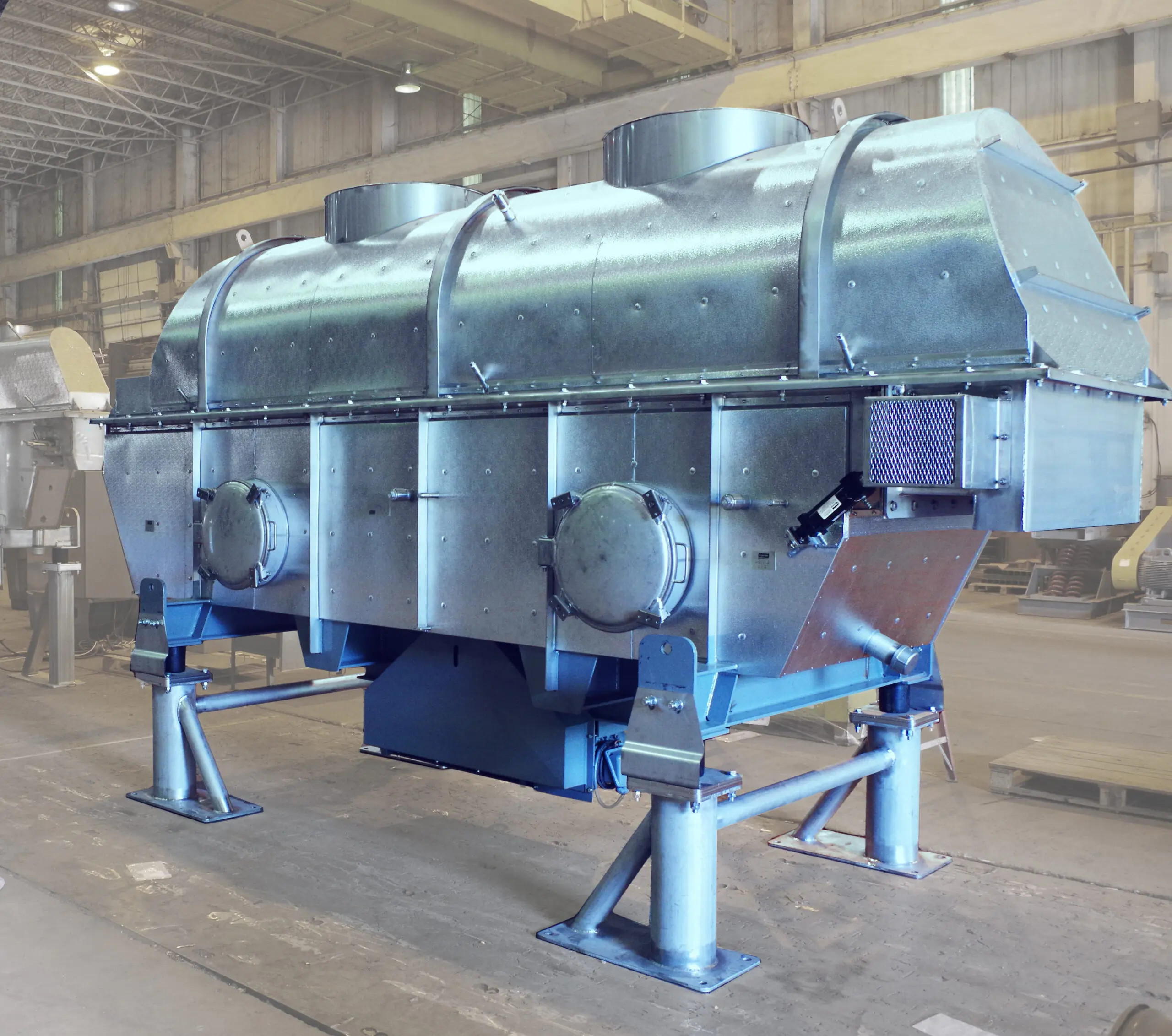
Why Thermal Processing Equipment Matters in Modern Industry
Thermal processing equipment applies controlled heat to transform raw materials into finished products across dozens of industries. If you’re exploring thermal processing, here’s what you need to know:
Core Equipment Types:
- Industrial Dryers – Remove moisture from bulk materials (fluid bed, flash, rotary)
- Industrial Coolers – Control temperature after heating to prevent damage
- Calciners – Enable high-temperature chemical reactions
- Kilns – Process materials at extreme temperatures
Primary Applications:
- Drying chemicals, minerals, and food products
- Cooling hot materials for safe handling
- Calcining limestone and other minerals
- Processing battery materials and advanced powders
The global thermal processing equipment market reached $11.5 billion in 2023 and is projected to grow to $17.8 billion by 2030 at a 6.5% annual growth rate. This expansion reflects the critical role these systems play in everything from food safety to advanced battery manufacturing.
Whether you’re drying metal powder for 3D printing, cooling salt after crystallization, or processing lithium-ion battery materials, the right thermal processing equipment directly impacts your product quality, energy costs, and production efficiency.
This guide explains how thermal processing works, compares equipment types for bulk material applications, and shows you how to select the right system for your specific process requirements. We’ll also explore emerging trends in automation, energy efficiency, and sustainability that are reshaping the industry.
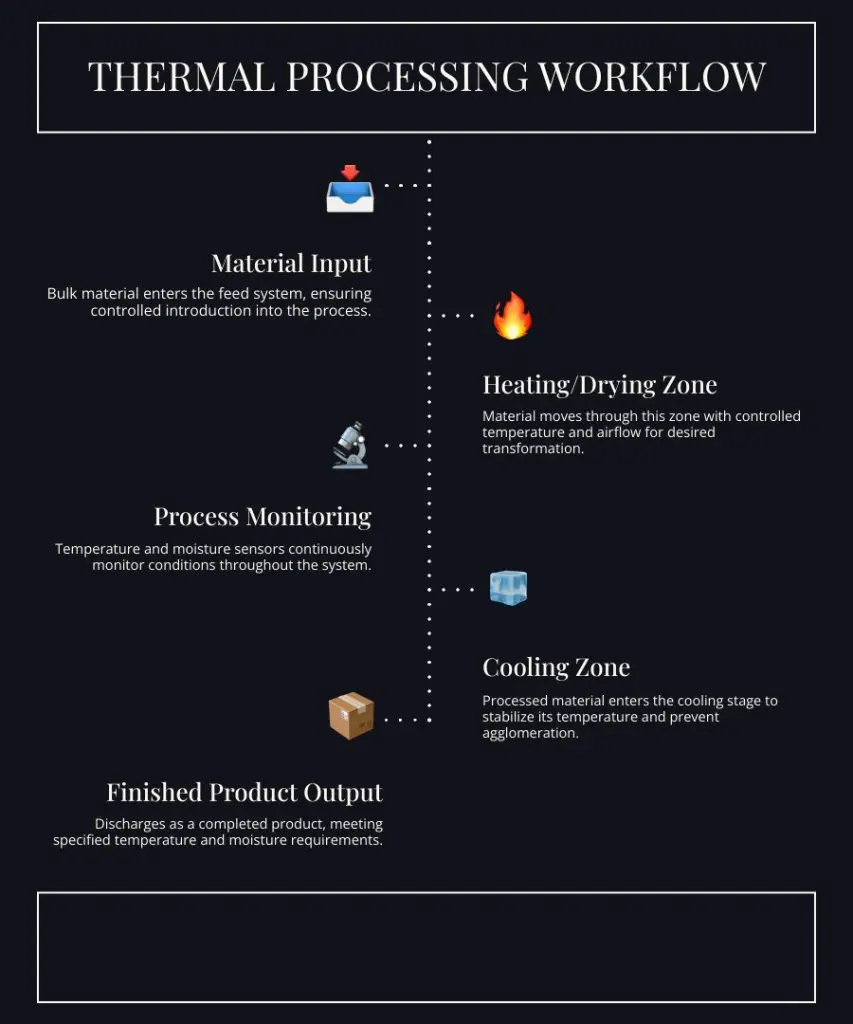
What is Thermal Processing? Core Functions and Principles
Thermal processing equipment uses controlled heat to transform raw materials into finished products. Whether drying wet minerals, cooling hot chemicals, or calcining limestone, the process uses precise temperature control to change a material’s properties.
The goal is to apply the precise heat treatment needed to achieve desired changes efficiently, maintaining product quality and minimizing energy waste.
Heat moves through materials in three fundamental ways: Conduction (direct contact), Convection (moving air or gas), and Radiation (electromagnetic waves). Understanding these heat transfer methods is key to controlling the process.
These methods power several core functions that manufacturers rely on. Drying & Cooling removes moisture or heat from bulk materials—crucial for product stability, safe handling, and preparing materials for the next processing step. Calcining applies high temperatures to drive off volatile compounds or trigger chemical changes in minerals and catalysts, all without melting the material. Sterilizing uses heat to eliminate microorganisms in food and pharmaceutical products, ensuring safety and extending shelf life. Roasting develops the flavors, colors, and textures we expect in products like coffee, nuts, and grains.
The way heat reaches your material makes a significant difference. In direct thermal processing, the heating medium—hot air or combustion gases—contacts the material directly. This approach offers excellent thermal efficiency but requires careful consideration of product compatibility and off-gas management.
Indirect thermal processing separates the heating medium from your material using a heat exchange surface. This method protects sensitive materials from contamination, contains off-gases for separate recovery, and gives you precise control over the processing environment. It’s the preferred choice when product purity matters most.
The industrial dryers market, a major segment of thermal processing equipment, demonstrates the growing importance of these technologies. Market analysts project growth from $4.5 billion in 2023 to $6.8 billion by 2028, representing an 8.6% annual growth rate. This expansion reflects how essential thermal processing has become across manufacturing sectors worldwide.
Primary Types of Thermal Processing Equipment for Bulk Materials
When we talk about thermal processing equipment for bulk materials, we’re entering a world where powders, granules, and crystals need special attention. These materials behave differently than liquids or solid pieces—they flow, clump, and have varying particle sizes. Our engineering expertise lies in designing solutions that respect these unique characteristics while delivering the precise thermal treatment your process demands.
Before we dive into specific equipment types, it’s worth understanding the fundamentals of how these systems actually work. If you’re curious about the mechanics, our guide on Understanding Thermal Processing Equipment: How It Works offers a comprehensive look at the principles that make thermal processing so effective.
Industrial Dryers: Removing Moisture with Precision
Drying might sound simple, but processing tons of material per hour with consistent quality is a science. The right industrial dryer transforms wet, unusable bulk materials into stable, valuable products.
Vibrating Fluid Bed Dryers are the workhorses of gentle, uniform drying. The fluidization principle is simple yet effective: vibration and heated air flowing through a perforated deck suspend material in a fluid-like state. This ensures each particle gets equal exposure to the drying air, preventing hot spots and clumping for consistent moisture removal. This gentle method is ideal for materials that might stick together or degrade with harsher drying. To see how this works, take a look at Vibrating Fluid Beds: How They Work.
For fine particles that need rapid drying without degradation, Flash Dryers are your answer. These systems dry materials in seconds. The material is dispersed into a high-velocity stream of hot gas, and the moisture is gone. This short exposure time is perfect for heat-sensitive materials. The differences between these approaches are significant, which is why we put together Flash Drying vs. Fluid Bed Drying to help you understand which might work best.
Tornesh Dryers are designed for sticky, pasty materials that clog other systems. Their unique rotor design breaks up agglomerates and forces thorough dispersion into the drying air, making them ideal for materials that clump when wet.
Selecting the right dryer is about matching the equipment to your material and process goals. That’s why we created Comparing Industrial Drying Equipment, a resource that walks you through the decision-making process.
Industrial Coolers: The Other Side of Thermal Control
If dryers add heat, coolers take it away—and they’re just as critical. If a material leaves your system too hot, it can cause problems. Hot materials can stick together, creating unwanted agglomerates. They can pose safety hazards for workers and might continue to react or change in undesirable ways.
Preventing agglomeration is a primary concern, as hot particles can fuse, turning free-flowing powder into lumps. Safe handling is equally important, as no one wants to bag material hot enough to burn. For many products, stabilizing properties through controlled cooling locks in the exact characteristics achieved during processing.
Our Vibrating Coolers use the same proven fluidization technology as our dryers, but with cool air. This provides gentle, uniform cooling. For applications needing complete separation between the cooling medium and your product, fluid bed coolers and indirect coolers circulate water or chilled air through heat exchange surfaces without touching your material.
Sometimes the most innovative solutions come from solving real-world problems. Our work described in New Cooler Technology Solves Salt Production Problem shows how custom engineering can tackle challenges that standard equipment cannot. To explore our full range of cooling solutions, visit our Coolers page.
Specialized thermal processing equipment
Beyond drying and cooling, thermal processing equipment extends into more specialized territory. Calciners operate at high temperatures to drive chemical reactions, remove impurities, or change crystalline structures. Unlike dryers, calciners fundamentally alter the material’s chemistry. Kilns take this further, operating at extreme temperatures for extended periods to fire ceramics, produce cement, or process ores.
Our Bulk Material Heat Exchanger systems offer precise thermal control for heating or cooling bulk solids, often using indirect heat transfer to prevent contamination while maintaining exact temperature profiles. These systems are ideal for pre-heating material before a reaction, cooling it afterward, or maintaining specific temperatures throughout processing.
Industrial Applications: Where Thermal Processing Makes an Impact
The beauty of thermal processing equipment lies in its incredible versatility. From the paint on your walls to the battery in your electric vehicle, controlled heat plays a foundational role in changing raw materials into the products that shape our daily lives.
We’ve engineered solutions for dozens of Industries, and each one presents unique challenges. Let’s explore where thermal processing makes its biggest impact.
Chemicals and Minerals
The chemical processing industry is massive, projected to reach $150.5 billion by 2027, and thermal processing equipment is essential to its success. Whether extracting value from raw minerals or synthesizing complex compounds, precise heat control is non-negotiable.
For example, Drying Pigments for Paint requires careful attention to prevent caking and ensure vibrant, consistent colors. Uneven drying can result in a clumpy mess instead of a smooth, uniform powder.
Minerals present their own challenges. Sand Drying Equipment Faces Unique Issues due to particle size variation and high volumes, while From Rock to Useful Material with Limestone Drying shows how thermal processing adds value to materials for construction, agriculture, and industrial use.
Even salt benefits from advanced processing. Our work with Vibrating Fluid Bed Rock Salt ensures uniform drying and cooling, critical for everything from road de-icing to food processing. Some chemicals we help dry are even used to make Drying Chemicals Celebrate with Fireworks possible.
Food and Agriculture
The global food processing equipment market is expected to reach $75.5 billion by 2027, and thermal processing equipment is fundamental to this growth. It is key to food safety, flavor development, and extending shelf life. Through precise heating and cooling, we help create products that are safe, flavorful, and appetizing.
Thermal treatment destroys harmful microorganisms through pasteurization, sterilization, and drying—processes that prevent spoilage and maintain quality from farm to table.
Consider breadcrumbs. Achieving the perfect texture and moisture content for Vibrating Fluid Bed Dryers for the Perfect Breadcrumb is a science. Too much moisture and they’ll mold; too little and they won’t provide the right crunch.
Thermal processing also handles the drying of spices to improve potency and shelf stability, the roasting of nuts to bring out rich flavors, and the processing of grains after harvest to prepare them for storage or milling. Each application requires different temperature profiles and residence times, which is why custom engineering matters.
Advanced and Emerging Materials
This is where thermal processing gets truly cutting-edge. The materials powering tomorrow’s technology demand extraordinary precision and purity, and thermal processing equipment rises to meet those standards.
For Drying Metal Powder for 3D Printing, even trace moisture can compromise an entire production run. These high-purity applications require equipment that can achieve and maintain incredibly tight tolerances.
The electric vehicle revolution has created explosive demand for battery materials, and thermal processing is central to production and sustainability. Lithium-Ion Battery Material Processing and Recycling involves handling sensitive materials that require precise temperature control at every stage. This sector will only grow in importance as the world shifts toward renewable energy.
Polymers and recycled plastics round out this category. Drying polymers before molding prevents defects in the final product. Meanwhile, thermal processing helps break down and prepare recycled plastics for their next life, supporting the circular economy.
Key Considerations for Selecting Thermal Processing Equipment
Choosing the right thermal processing equipment is like commissioning a custom tool that must work perfectly with your material, meet your process goals, and fit your production line. This is where custom engineering is essential.
Every material has unique properties—some are heat-sensitive, others abrasive. Understanding these characteristics upfront is crucial. That’s why we advocate for thorough Lab Testing with your actual materials before any equipment is built. This pre-engineering step validates the process and prevents costly issues later.
Material Properties and Process Goals
Your material tells us almost everything we need to know. Particle size matters tremendously, as fine powders behave differently than coarse granules. A material’s starting and target moisture content determine the required thermal energy and processing time.
Temperature sensitivity is perhaps the most critical factor. Can your material handle direct hot gases, or does it need the gentler touch of indirect heating? Some materials degrade or discolor at low temperatures, while others withstand intense heat. This characteristic often determines whether you need direct or Indirect Thermal Processing.
If your material is abrasive—like sand or minerals—the equipment needs wear-resistant surfaces and robust construction. Similarly, sticky materials require designs that prevent buildup and ensure smooth flow.
Your desired output specifications drive everything else. What throughput do you need? What is the acceptable range for final moisture content and uniformity? Does particle size distribution need to stay within tight tolerances? These are the benchmarks your equipment must reliably hit.
For anyone considering fluid bed technology, our White Paper: Considerations for the Selection of a Vibratory Fluid Bed Dryer walks through these considerations in detail.
Batch vs. Continuous Systems
One of the first decisions is between batch and continuous operation, a choice that shapes your equipment design and operational approach.
Batch processing shines when you need flexibility for multiple products, frequent recipe changes, or smaller production volumes. You process a defined quantity, complete the cycle, and start fresh. This approach offers excellent control over each batch and typically requires lower initial capital investment for smaller-scale operations.
Continuous processing is the workhorse of high-volume production. Material flows in steadily at one end and exits at the other. Once dialed in, continuous systems deliver exceptional consistency and throughput. They are optimized for a specific process, so switching between materials is less straightforward than with batch systems.
The economic considerations matter too. Continuous systems generally require higher upfront capital but offer lower operating costs per unit at scale. Batch systems can be more economical for diverse products or smaller volumes. Consider labor, energy, and maintenance needs over the equipment’s lifetime.
Production Scale and Customization
Most successful thermal processing projects follow a logical progression: lab-scale testing, then pilot-scale validation, and finally full production implementation. This staged approach is smart business, as it reduces risk and builds knowledge at each step.
Scalability is where many projects stumble. What works in a lab-scale unit doesn’t always translate directly to production scale, as heat transfer dynamics and material flow patterns change. This is why we emphasize Custom Equipment designed for your application rather than force-fitting a standard unit.
Custom engineering means your thermal processing equipment is built around your material, process, and production goals. Every element—vessel dimensions, heating system, airflow patterns, vibration characteristics—is optimized for your specific needs. This upfront engineering results in equipment that performs reliably and efficiently from day one.
The Future of Thermal Processing: Technology, Automation, and Sustainability
The thermal processing equipment industry is rapidly evolving, driven by rising energy costs, stricter environmental regulations, and demands for higher product quality. These pressures are catalysts for smarter, cleaner, and more efficient solutions.
Technological Advancements and Efficiency
In thermal processing equipment, wasted energy is wasted money. The industry is therefore laser-focused on maximizing the efficiency of these systems.
Energy recovery systems have become game-changers. Recuperators capture waste heat from exhaust gases to pre-heat incoming combustion air. Regenerative burners take this further, using ceramic matrices to store and release heat, leading to substantial fuel savings.
Hybrid systems are another key development. Combining different heating methods or integrating multiple process steps into one unit can yield surprising efficiency gains. As we’ve explored in One Dryer is Better Than Two, optimizing a single, well-designed system often beats running multiple separate units.
Modern thermal processing equipment also benefits from improved insulation materials that keep heat inside the process chamber. There’s also a growing electrification trend as power grids become greener. Electric heating offers precise control and can reduce direct emissions, making it increasingly attractive.
The Role of Automation and Control
Today’s thermal processing equipment is about applying intelligent heat. The difference between yesterday’s equipment and today’s is like comparing a thermostat to a smartphone.
PLC-based systems serve as the brains of modern equipment, orchestrating complex sequences. Advanced sensors continuously monitor temperature, moisture, airflow, and pressure, feeding real-time data to control systems. Data logging and analytics allow engineers to spot trends, troubleshoot issues, and continuously improve processes.
The real magic is process optimization. Modern systems can adjust parameters on the fly to compensate for variations in material or conditions. Even more impressive is predictive maintenance, where equipment signals when it needs attention before a breakdown. By monitoring vibration, bearing temperatures, and other indicators, these systems flag potential problems early, allowing for scheduled maintenance.
The benefits are clear: increased safety, improved consistency, lower energy costs, and fewer costly surprises. Equipment configured with advanced controls, like those integrating Rockwell Automation systems, delivers the reliability modern production demands.
Safety and Maintenance for modern thermal processing equipment
Working with high temperatures, pressure systems, and combustible materials demands respect. Thermal processing equipment operates in environments where safety is paramount. We build robust safety protocols into every design: interlocks, emergency shutdown systems, explosion protection for combustible dusts, and comprehensive safeguards that meet global standards.
Environmental compliance is equally critical. Effective emissions control systems scrub exhaust gases, while responsible wastewater management ensures we’re not just shifting problems elsewhere. These are fundamental to modern equipment design.
Even the toughest equipment faces operational challenges. Abrasive materials cause wear, high temperatures cause thermal stress, and sticky products can foul heat transfer surfaces. Regular cleaning procedures are essential to maintaining efficiency and preventing contamination.
When it comes to replacement parts, using genuine OEM parts makes all the difference. Generic substitutes rarely deliver the same performance or longevity. Our dedicated Sales & Service team provides expert support, including inspection programs and responsive field service. We help identify potential issues before they become critical failures, minimizing downtime and extending the life of your equipment.
Conclusion
From basic heat transfer principles to sophisticated equipment, it’s clear that thermal processing equipment is the backbone of modern manufacturing. The vibrant pigments in paint, the crispy texture of breadcrumbs, and the advanced materials in electric vehicle batteries all depend on this technology.
What matters most is choosing equipment that fits your unique needs. There is no “standard solution” for bulk materials. Your material’s unique characteristics demand careful consideration, which is why custom-engineered solutions, backed by lab testing and expert guidance, make the difference between a process that works and one that excels.
The future of this industry is bright, with a convergence of energy efficiency, intelligent automation, and sustainable practices. Systems are becoming smarter, more precise, and more environmentally responsible.
At Carrier Vibrating Equipment, with facilities in Louisville, KY; Nivelles, Belgium; and Shanghai, China, we’ve built our reputation on delivering individually engineered solutions our customers can rely on. We understand that your success depends on equipment that performs consistently, efficiently, and safely.
Whether you’re processing traditional materials or pioneering new applications, we’re here to help. If you’re interested in how these technologies are shaping tomorrow’s innovations, explore how advanced thermal processing is revolutionizing critical sectors like lithium-ion battery material processing and recycling.
Ready to discuss your specific thermal processing challenges? Let’s talk about how we can engineer the perfect solution for your needs.